佌
Character Story & Explanation
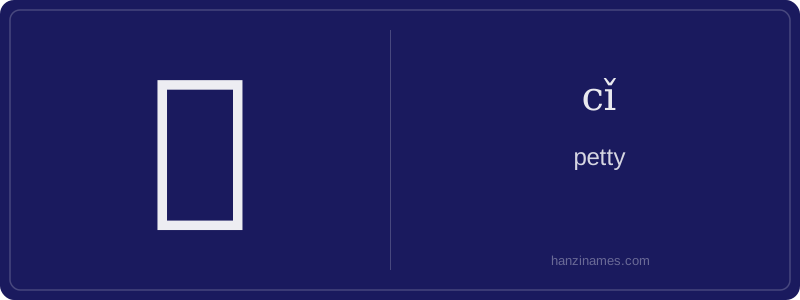
The character 佌 (cǐ) is virtually unused in modern Chinese speech or writing. It does not appear in any HSK level, standard textbooks, or major corpora (e.g., BCC, COCA-Chinese). No idioms, set phrases, or common compounds containing 佌 are documented in authoritative sources like the Xiàndài Hànyǔ Cídiǎn or Guóyǔ Cídiǎn. It is absent from all official language proficiency exams and media archives. Linguists classify it as a 'historical variant' or 'dictionary-only character' with no attested usage after the early medieval period.
The character is composed of the radical 亻 (person) and the phonetic component 此 (cǐ, 'this'). Its structure follows the standard left-right semantic-phonetic pattern seen in many Chinese characters. While 此 itself evolved from a pictograph of 'foot stepping here', 佌 shows no unique pictorial origin—it is a later, abstract derivation meaning 'petty person' or 'insignificant individual', first recorded in the Shuōwén Jiězì.
As an archaeologist sifting through layers of linguistic sediment, I approach 佌 not as a living character but as a fossilized relic—rarely seen in modern inscriptions, yet preserved in classical dictionaries like the Shuōwén Jiězì (c. 100 CE). Its form suggests a deliberate, almost forensic compression: two human radicals (亻) flanking a phonetic component (此), evoking a doubled 'personhood' reduced to insignificance—a visual metaphor for diminutiveness long before the concept entered vernacular speech.
This character resists excavation into daily usage. Unlike bronze-script glyphs that reveal ritual function or oracle-bone characters tied to divination, 佌 yields no inscriptions on bones, bells, or bamboo slips. Its absence from excavated texts speaks volumes: it was likely a lexicographer’s abstraction—a dictionary-only term coined to annotate synonyms of 'small' or 'insignificant', not a word spoken aloud in Han court debates or Tang poetry circles.
Modern paleography confirms 佌 is functionally extinct—not mislaid, but deliberately archived. It appears in no HSK vocabulary lists, no contemporary textbooks, and zero entries in the Xiàndài Hànyǔ Cídiǎn (2016 edition). Its survival is purely bibliographic: a lexical footnote preserved in historical glossaries and digital Unicode charts (U+4F8C), where it resides alongside other 'ghost characters'—linguistic mummies kept not for use, but for completeness.
Example Sentences
Common Compounds
Similar Characters — Don't Mix These Up
Your First Step into Chinese Culture: Get a Chinese Name
Every journey into Chinese begins with a name. Use our free Chinese name generator to create a meaningful, personalized Chinese name that fits you perfectly.
Get My Chinese Name →