佚
Character Story & Explanation
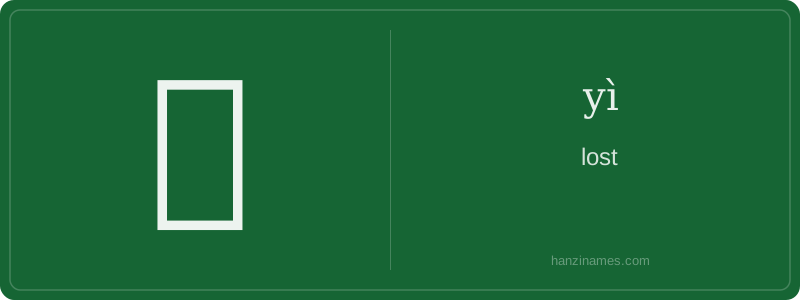
In modern Chinese, 佚 appears most frequently in the compound 佚名 (yìmíng), meaning 'anonymous' — used on forms, art credits, and online posts when the creator chooses not to disclose their name. It also appears in academic contexts like '佚文' (yìwén, 'lost passages') referring to fragments of ancient texts recovered from Dunhuang manuscripts or bamboo slips. Historically, the Zuo Zhuan mentions '史佚' (Shǐ Yì), a revered archivist of the Western Zhou dynasty, underscoring the character’s association with record-keeping and its fragility.
The character’s structure combines 亻 (person) and 乙 (yǐ, the second of the Ten Celestial Stems). While 乙 was originally a pictograph resembling a bent line (possibly a seed sprouting), its use here is phonetic — providing the 'yì' sound. No oracle bone or bronze inscription of 佚 has been confirmed; it first appears reliably in Warring States bamboo texts, consistently meaning 'absent', 'unrecorded', or 'withdrawn'.
The character 佚 (yì) evokes quiet disappearance — not dramatic loss, but gentle vanishing, like a name slipping from memory or an ancient text fading into obscurity. Its radical 亻 (person) hints at human agency or absence, while the right component 乙 (yǐ), originally a celestial stem denoting order and sequence, suggests something displaced from its proper place. In classical usage, 佚 often describes people who withdrew from official life — recluses, forgotten scholars, or texts no longer transmitted.
Unlike common words for 'lost' like 丢 (diū) or 失 (shī), 佚 carries literary weight and historical resonance. It appears in formal contexts: lost manuscripts, unrecorded philosophers, or unnamed artisans whose work survives without attribution. This nuance makes it rare in spoken Mandarin but vital in academic, bibliographic, and philosophical discourse — especially when discussing gaps in China’s cultural record.
Modern learners encounter 佚 mainly through classical references or compound terms like 佚名 (yìmíng, 'anonymous') or 史佚 (Shǐ Yì), a famed Western Zhou historian. Its seven-stroke form is deceptively simple, yet its meaning lingers in the margins of history — reminding us that 'lost' isn’t always empty; sometimes it’s full of silenced voices waiting to be recovered.
Example Sentences
Common Compounds
Similar Characters — Don't Mix These Up
Your First Step into Chinese Culture: Get a Chinese Name
Every journey into Chinese begins with a name. Use our free Chinese name generator to create a meaningful, personalized Chinese name that fits you perfectly.
Get My Chinese Name →