每
Character Story & Explanation
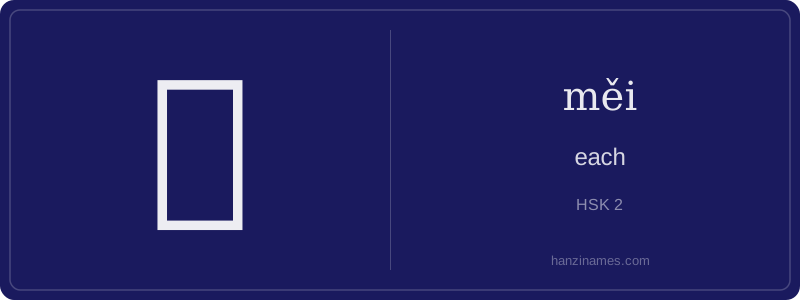
In daily life, 每 is indispensable for expressing routine and universality: 'every day' (每天), 'every student' (每个学生), and 'every time' (每次) appear constantly in speech, signage, apps, and textbooks. It anchors HSK 2 grammar patterns like 每 + [time noun] and 每 + 个 + [noun]. Historically, it appears in the *Zuo Zhuan* (4th c. BCE) describing tribute paid 'each year' (每年), confirming its early grammatical role in recording cyclical obligations.
The character evolved from seal script (c. 3rd c. BCE), where it clearly combines 母 (mother, radical) with an upper element derived from 帀 (a now-obsolete character meaning 'all-around coverage'). While not a pictograph, its structure reflects conceptual composition: 'mother' as source + 'comprehensive scope' = 'each (as part of a complete, repeating set)'. No oracle bone form exists—its earliest attestation is in Warring States bamboo texts.
As an archaeologist brushing dust from a Han dynasty bamboo slip, I find 每 inscribed in clerical script—its form already stable, its meaning crystallized: not just 'each' as a quantifier, but 'each' as a rhythmic pulse in time and recurrence. Unlike static numerals, 每 carries temporal weight—marking repetition across days, months, or generations. Its presence in early administrative texts signals bureaucratic precision: tax records noting 'each household', military rosters listing 'each soldier'. This wasn’t abstract math—it was governance made tangible.
Zooming in on the character’s structure, we see 母 (mǔ, 'mother') as the radical—a clue not to maternity, but to origin and generative recurrence. In ancient Chinese thought, 'mother' embodies source and cyclical renewal, much like the moon’s phases or seasonal returns. The upper component, (a variant of 帀, now obsolete), once denoted 'to cover all around', reinforcing totality. So 每 emerged not as a mere counter, but as 'the full, recurring cycle applied to every unit'—a philosophical compact in seven strokes.
The bronze-age precursors are elusive—no oracle-bone form survives—but by the Warring States period, 每 appears consistently in bamboo manuscripts like the *Shanghai Museum Chu Slips*, always paired with time nouns (e.g., 每月, 'each month'). Its semantic stability over 2,300 years is extraordinary: modern Mandarin speakers read classical texts containing 每 without gloss. That continuity suggests it encoded a cognitive universal—humanity’s need to parcel time and count entities collectively, yet individually. It’s less a word than a cognitive tool fossilized in ink.
Example Sentences
Common Compounds
Similar Characters — Don't Mix These Up
Your First Step into Chinese Culture: Get a Chinese Name
Every journey into Chinese begins with a name. Use our free Chinese name generator to create a meaningful, personalized Chinese name that fits you perfectly.
Get My Chinese Name →