佧
Character Story & Explanation
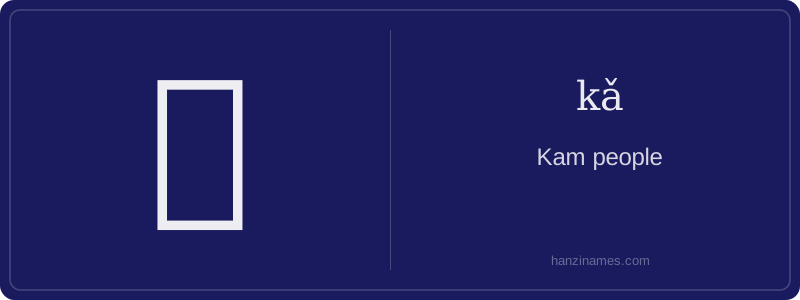
The character 佧 appears almost exclusively in formal, historical, or administrative contexts related to China’s ethnic classification system established in the 1950s. It is used in official documents, academic publications, and museum signage to refer to the Kam people—particularly in references to their traditional wooden drum towers (zhai lou), multi-part singing (Kam Grand Choir), and Dong language (often conflated with Kam in older sources). It is never used colloquially or in media.
The character is a modern coinage—not found in pre-20th-century texts. Its form combines the human radical 亻 (indicating a person or group) with 卡 (kǎ), a phonetic component borrowed for sound, not meaning. This follows standard Chinese practice for transcribing non-Han ethnonyms (e.g., 傣 for Dai, 畲 for She). No oracle bone or seal script forms exist; it entered standardized dictionaries only after the 1954 Ethnic Identification Project.
The character 佧 (kǎ) is a rare, historically specific term referring to the Kam (or Kam-Sui) ethnic group—an ancient Tai-Kadai-speaking people native to southern China’s Guizhou, Guangxi, and Hunan provinces. It appears almost exclusively in academic, ethnographic, or archival contexts, not in modern daily language. Unlike common Chinese characters with broad semantic ranges, 佧 carries no abstract or metaphorical meanings—it functions purely as an ethnonymic logograph, preserved in official records and linguistic studies.
Western cultural equivalents include terms like 'Algonquin' or 'Yoruba'—names that denote distinct Indigenous peoples with unique languages, customs, and historical sovereignty. Like these, 佧 is not a generic descriptor but a proper noun rooted in self-identification and colonial-era documentation. Its usage parallels how English retains indigenous group names (e.g., 'Inuit', 'Maori')—respecting autonomy while acknowledging administrative classification by external authorities.
Unlike widely taught characters in HSK curricula, 佧 is absent from all six HSK levels due to its extreme rarity and specialized function. Learners are unlikely to encounter it outside ethnology textbooks, museum exhibits on Chinese minorities, or government-published minority language surveys. Its seven-stroke structure (亻+卡) reflects phonetic borrowing: the radical 亻 signals 'person/ethnic group', while 卡 (kǎ) approximates pronunciation—similar to how English uses 'Sioux' (a French misrendering of 'Nakota') rather than the group’s autonym.
Example Sentences
Common Compounds
Similar Characters — Don't Mix These Up
Your First Step into Chinese Culture: Get a Chinese Name
Every journey into Chinese begins with a name. Use our free Chinese name generator to create a meaningful, personalized Chinese name that fits you perfectly.
Get My Chinese Name →