佯
Character Story & Explanation
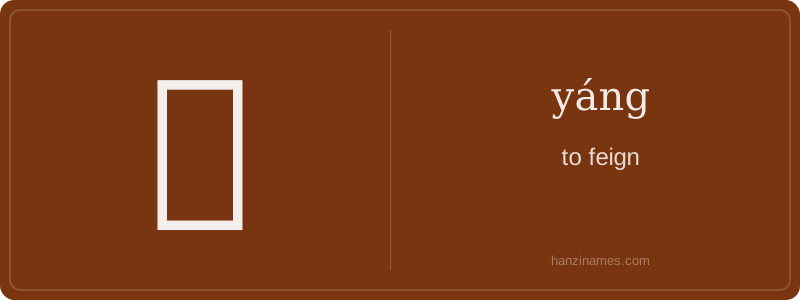
In contemporary Chinese media and formal writing, 佯 appears in phrases like 佯装不知 (yángzhuāng bùzhī, 'feign ignorance')—a documented diplomatic tactic observed in official statements and analytical journalism. It’s also frequent in historical novels and CCTV documentaries about strategists like Zhuge Liang, who famously 佯攻 (yánggōng, 'feigned attack') to divert enemy forces—a real military tactic recorded in the Records of the Three Kingdoms.
The character is not pictographic; its right component 羊 serves as a phonetic indicator (both 佯 and 羊 are pronounced yáng), while the left 亻 ('person') signals semantic category. No oracle-bone or bronze script forms survive for 佯—it first appears in Warring States bamboo texts as a phonosemantic compound, consistent with standard Han-dynasty character formation principles.
The character 佯 (yáng) is a subtle yet powerful verb meaning 'to feign' or 'to pretend'—not in a childish or playful way, but with deliberate, often strategic intent. It appears frequently in literary, historical, and formal contexts, where nuance matters: someone may 佯装 (yángzhuāng) ignorance to avoid conflict, or 佯作 (yángzuò) calm during crisis. Its eight-stroke structure reflects precision—every line contributes to its quiet intensity.
Unlike colloquial synonyms like 假装 (jiǎzhuāng), 佯 carries a classical register and psychological depth. It suggests conscious artifice, often layered with irony or self-awareness—think of a diplomat smiling while withholding truth, or a scholar feigning disinterest to test sincerity. This gravitas makes it common in classical poetry, Ming-Qing fiction, and modern political commentary.
Because it’s rarely used in casual speech, learners encounter 佯 most often in written materials: news analysis, historical dramas, or HSK-advanced reading passages. Its radical 亻 (person) anchors it in human behavior, while the right side 羊 (yáng, 'sheep')—though phonetic here—evokes softness masking strength, reinforcing the idea of gentle deception. Mastery signals nuanced understanding of Chinese rhetorical culture.
Example Sentences
Common Compounds
Similar Characters — Don't Mix These Up
Your First Step into Chinese Culture: Get a Chinese Name
Every journey into Chinese begins with a name. Use our free Chinese name generator to create a meaningful, personalized Chinese name that fits you perfectly.
Get My Chinese Name →