佺
Character Story & Explanation
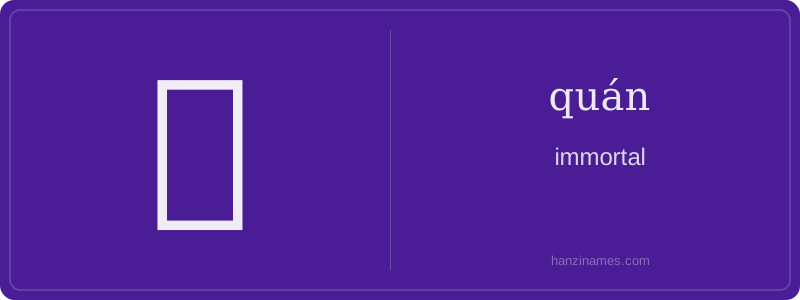
The character 佺 is exceptionally rare in modern Chinese daily life. It appears almost exclusively in classical literature, Daoist texts, historical anthologies of immortals, and scholarly discussions of Chinese mythology. No HSK-level textbook includes it; it does not occur in contemporary news, social media, or everyday speech. Its only stable usage is in proper nouns—most notably the legendary immortal Changsong 佺 (Chángsōng Quán), referenced in the Liexian Zhuan (c. 1st century BCE–1st century CE) as a mountain-dwelling sage who mastered breath control and herbal elixirs.
The character is a late-developing phono-semantic compound: 亻 (person radical) + 全 (quán, phonetic and semantic anchor meaning 'complete, unblemished'). Its form first appears reliably in Eastern Han steles and Six Dynasties manuscripts—not in oracle bones or bronze inscriptions. Today, it survives only in academic contexts, classical poetry anthologies, and Daoist temple inscriptions.
As an archaeologist sifting through Han dynasty bamboo slips and Tang dynasty Daoist manuscripts, I found 佺 not as a common word—but as a whispered glyph in immortality cults. Its earliest secure attestations appear in the Shenxian Zhuan (Biographies of Divine Immortals, c. 4th century CE), where it names celestial beings who ‘drink dew and ride clouds.’ Unlike everyday characters, 佺 was never standardized for administrative use—its rarity suggests ritual or literary exclusivity.
This character surfaces almost exclusively in compound names of legendary xian (immortals), such as Qiu Chuji’s disciple Wang Zhijian, whose posthumous title included 佺. Excavated Dunhuang manuscripts show scribes using it with deliberate calligraphic flourish—often with elongated final strokes—indicating reverence rather than utility. Its absence from early dictionaries like Shuowen Jiezi (121 CE) confirms its late, specialized emergence.
Modern linguistic analysis reveals 佺 is a phono-semantic compound: the ‘person’ radical (亻) signals human-like transcendence, while the phonetic component 全 (quán, ‘complete, whole’) conveys the Daoist ideal of perfected, undecaying existence. This isn’t mere longevity—it’s ontological wholeness: body, breath, and spirit fused beyond death. Archaeologically, 佺 is less a lexical tool and more a talismanic signifier—etched on tomb inscriptions to invoke eternal presence.
Example Sentences
Common Compounds
Similar Characters — Don't Mix These Up
Your First Step into Chinese Culture: Get a Chinese Name
Every journey into Chinese begins with a name. Use our free Chinese name generator to create a meaningful, personalized Chinese name that fits you perfectly.
Get My Chinese Name →