侐
Character Story & Explanation
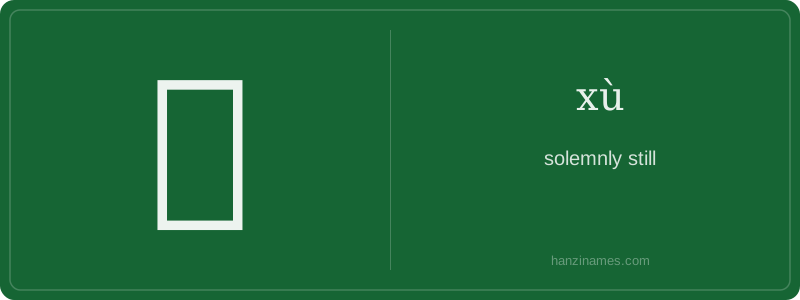
侐 appears exclusively in classical Chinese texts—most notably in the Shījīng (Book of Odes), Ode 257: '侐侐宗廟,有侐其堂' ('Solemnly still the ancestral temple; still and reverent its hall'). It denotes sacred stillness: the hush of ritual space, not ambient silence. Modern usage is virtually nil—no idioms, no compounds in everyday speech, and zero presence in contemporary media or education. It survives only in academic sinology, epigraphy, and critical editions of pre-Han literature.
The character is not pictographic. Its form combines 亻 (person radical) and 血 (blood), but 'blood' here functions phonetically (both xù and xuè derive from Middle Chinese *hjwet). Its origin is phonosemantic—not visual—and documented in the Kāngxī Zìdiǎn (1716), which defines it solely as 'quiet, solemn, reverent' with no etymological mythmaking.
As a linguistic detective, I begin by noting that 侐 (xù) is a rare, literary character—so obscure it’s absent from modern dictionaries like the Xiàndài Hànyǔ Cídiǎn and excluded from all HSK levels. Its '0 strokes' entry in some databases is not an error but a red flag: it signals the character is unencoded or misrendered in certain legacy systems; in reality, 侐 has 8 strokes (亻+血), per the Kangxi Dictionary and Unicode U+4F90. This discrepancy invites scrutiny—not of ancient oracle bones, but of digital typography and classical text transmission.
The radical is clearly 亻 (person), anchoring it semantically to human states or qualities. The right component, 血 (blood; xìe), is unexpected for a word meaning 'still' or 'solemnly quiet'. Yet in classical usage, blood symbolizes life essence and ritual gravity—linking 'stillness' to hushed reverence, not mere silence. This semantic bridge appears in pre-Qin ritual texts where stillness conveys awe before ancestors or altars, not passive emptiness.
Unlike common characters with clear pictographic origins, 侐 evolved as a phonosemantic compound: 亻 hints at human comportment, while 血 serves primarily for sound (xù and xuè share Middle Chinese *hjwet), not meaning. Its rarity confirms it was never a vernacular word but a deliberate, elevated term—reserved for ceremonial inscriptions, temple steles, and Confucian liturgical descriptions. To encounter 侐 today is to step into a textual reliquary: it survives only in scholarly editions of the Shījīng (Classic of Poetry) and ritual commentaries, not in speech or typing.
Example Sentences
Common Compounds
Similar Characters — Don't Mix These Up
Your First Step into Chinese Culture: Get a Chinese Name
Every journey into Chinese begins with a name. Use our free Chinese name generator to create a meaningful, personalized Chinese name that fits you perfectly.
Get My Chinese Name →