侔
Character Story & Explanation
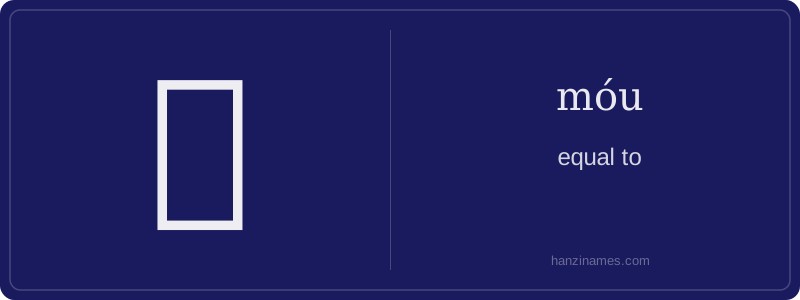
侔 is virtually absent from spoken Mandarin and daily conversation. It appears almost exclusively in formal, literary, or classical contexts—especially in idioms like ‘侔色揣称’ (móu sè chuǎi chēng), a phrase from Qing dynasty literary criticism meaning 'to match color and weigh expression', describing meticulous stylistic balance. It also occurs in pre-modern texts like the Zuo Zhuan and Han Feizi, where it conveys rigorous equivalence (e.g., 'his virtue 侔 Yao and Shun'). Modern usage is confined to scholarly writing, rhetorical analysis, or poetic diction.
The character is not pictographic; it’s a phono-semantic compound (形声字). The left side 亻 indicates human-related action (here: comparing or equating); the right side 牟 provides pronunciation (móu) and historically evoked resonance or matching tone—consistent with its meaning of 'equalizing' or 'paralleling'.
Our detective begins at the crime scene: the character 侔, written with just eight strokes and bearing the human radical 亻. At first glance, it looks deceptively simple—like a person (亻) standing beside a phonetic component (牟, móu), which historically carried both sound and semantic weight. But nothing is incidental in Chinese script: the radical signals human agency or comparison—fitting for a word meaning 'to match' or 'be equal to'.
Zooming in on the right side, 牟 was originally a pictograph of a cow’s call (like ‘moo’), later borrowed for its sound and associated with ‘seeking’ or ‘drawing level’. In 侔, it functions phonetically *and* semantically—suggesting deliberate alignment between two entities. This dual role reflects classical Chinese’s economy of form: one component pulls double duty, like a witness who both heard *and* saw the event.
Unlike common synonyms like 相似 (xiāngsì, 'similar') or 类似 (lèisì, 'analogous'), 侔 is literary, precise, and often evaluative—it implies parity so close it borders on equivalence. Its rarity in speech makes it a fingerprint at high-register crime scenes: classical texts, legal documents, and rhetorical essays where exact correspondence matters more than vague resemblance.
Example Sentences
Common Compounds
Similar Characters — Don't Mix These Up
Your First Step into Chinese Culture: Get a Chinese Name
Every journey into Chinese begins with a name. Use our free Chinese name generator to create a meaningful, personalized Chinese name that fits you perfectly.
Get My Chinese Name →