侜
Character Story & Explanation
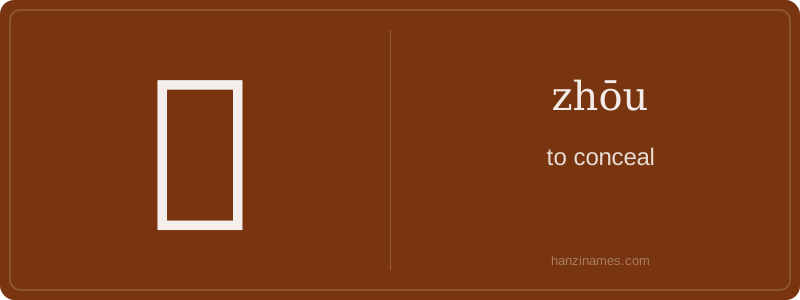
侜 appears almost exclusively in ancient Chinese lexicography and classical literature. The earliest authoritative record is in Xu Shen’s *Shuōwén Jiězì* (c. 100 CE), where it’s defined as ‘to conceal’ (詐也, though later editions read 隱也). It does not appear in the *Analects*, *Dao De Jing*, or major Tang poetry. No modern idiom or common phrase uses 侜—it’s absent from the *Xiàndài Hànyǔ Cídiǎn* (Contemporary Chinese Dictionary) and the *GB 2312* character set.
The character’s form combines 亻 (person) and 舟 (boat; used here solely for pronunciation, zhōu). There is no pictographic or archaeological evidence linking it to boats or water—it’s a phonetic loan character. Today, if encountered at all, it’s in academic contexts: sinology seminars, critical editions of early dictionaries, or calligraphy demonstrations of rare characters.
Hi students! Let’s talk about the character 侜 (zhōu). It’s a rare, classical character—not used in modern daily speech or writing. You won’t find it in textbooks, apps, or HSK exams. Its core meaning is 'to conceal' or 'to deceive by hiding the truth', often with a negative, deliberate connotation—like concealing facts to mislead someone. Though it looks simple, its rarity means even many native speakers may not recognize it without context.
This character belongs to the 'person' radical (亻), indicating human action or behavior—fitting for an intentional act like deception. It’s composed of 侜 = 亻 + 舟 (zhōu, 'boat'), but this is *not* a phonetic-semantic compound in the usual sense—the 'boat' component here is purely phonetic (both share the zhōu sound), not semantic. Don’t assume it has anything to do with boats!
As a beginner, your priority should be high-frequency characters first. 侜 is a great example of why learning *frequency* matters as much as meaning. You’ll encounter it only in pre-Qin or Han dynasty texts (e.g., the *Shuōwén Jiězì* dictionary) or poetic allusions—not in WeChat messages or restaurant menus. Treat it like a linguistic artifact: interesting, instructive, but not essential for communication.
Example Sentences
Common Compounds
Similar Characters — Don't Mix These Up
Your First Step into Chinese Culture: Get a Chinese Name
Every journey into Chinese begins with a name. Use our free Chinese name generator to create a meaningful, personalized Chinese name that fits you perfectly.
Get My Chinese Name →