侹
Character Story & Explanation
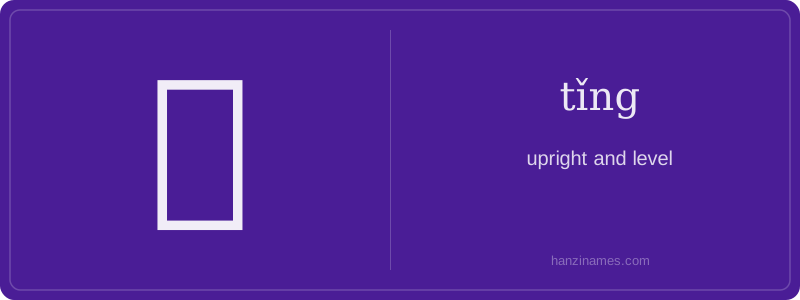
侹 is extremely rare in modern daily usage and does not appear in any HSK vocabulary list, contemporary textbooks, or mainstream media. It is absent from the 2013 General Standard Chinese Character Table and is classified as a 'variant' or 'literary archaic' character. No idioms (chengyu) contain 侹, and it appears only in pre-modern texts—primarily classical poetry and technical descriptions of architecture or sculpture, where it denotes structural perpendicularity and balance.
The character is composed of the 'person' radical (亻) and the phonetic component 廷 (tíng, 'court'). Its earliest attestation is in the *Kangxi Dictionary* (1716), which defines it as 'upright and level' (直而平). Though not pictographic, its structure reflects the human body (亻) aligned with the imperial court’s symbolic order (廷)—a metaphor for moral and physical centrality.
The character 侹 (tǐng) embodies a quiet yet profound ideal in Chinese cosmology: the harmony of vertical integrity and horizontal balance. Unlike Western notions of 'straight' as rigid linearity, 侹 suggests an effortless, natural uprightness—like a mature pine standing unwavering amid wind and snow. This reflects the Daoist and Confucian reverence for *zìrán* (spontaneous authenticity) and *zhèng* (moral uprightness), where true straightness arises not from force, but from inner alignment with cosmic order.
In classical Chinese thought, levelness (平 píng) and straightness (直 zhí) are ethical metaphors: a ruler’s justice must be ‘level’ like a carpenter’s water level, and their conduct ‘straight’ like a plumb line. 侹 synthesizes both—connoting structural soundness *and* moral rectitude. Its rarity today doesn’t diminish its philosophical weight; rather, it survives as a lexical fossil preserving an ancient standard of embodied virtue.
This character invites reflection on how Chinese language encodes ethics in morphology. While common characters like 正 (zhèng, 'correct') or 直 (zhí, 'direct') appear frequently, 侹 lingers in specialized contexts—architecture, martial arts, calligraphy—where physical posture mirrors ethical stance. To say something is 侹 is to affirm its rooted stability and unforced symmetry: a worldview where geometry, ethics, and aesthetics converge in stillness.
Example Sentences
Common Compounds
Similar Characters — Don't Mix These Up
Your First Step into Chinese Culture: Get a Chinese Name
Every journey into Chinese begins with a name. Use our free Chinese name generator to create a meaningful, personalized Chinese name that fits you perfectly.
Get My Chinese Name →