俎
Character Story & Explanation
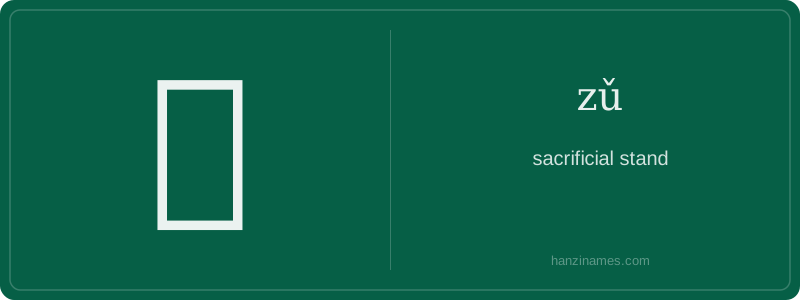
Today, 俎 is virtually absent from spoken Mandarin and rarely handwritten outside academic, ritual, or literary contexts. It survives primarily in fixed classical expressions—most notably the idiom 人为刀俎,我为鱼肉 (rén wéi dāo zǔ, wǒ wéi yú ròu), meaning ‘Others hold the knife and cutting board; I am the fish and meat’—a metaphor for powerlessness, famously quoted in Sima Qian’s Records of the Grand Historian (c. 94 BCE) describing a life-or-death banquet scene.
The character’s earliest confirmed form is a bronze inscription from the Western Zhou (1046–771 BCE), depicting a low rectangular stand with legs, used to hold sacrificial meats before ancestral altars. No oracle bone form is securely attested; its shape stabilized in bronze script as a platform + ‘meat’ signifier (且) + structural support—later misanalyzed as containing 人, though that radical was formally assigned during Han dynasty dictionary compilation.
Our detective begins at the Shāng dynasty oracle bones and Zhou bronze inscriptions—where 俎 first appears as a clear pictograph: a wooden platform (the horizontal strokes) supporting sacrificial meat (the 'meat' component, now stylized as 且), flanked by legs or supports. The radical 人 (person) isn’t literal here—it’s a later semantic classifier added during clerical script standardization to signal ritual human agency: this object exists *for people* performing rites.
Zooming in on the character’s anatomy: the top two horizontal lines represent the flat surface; the middle ‘且’ is a phonetic-semantic compound derived from ancient ‘meat offering’ glyphs; the bottom ‘人’ radical anchors it in human ritual context—not ‘a person,’ but ‘used by persons in ceremony.’ Stroke order reveals intentionality: write the platform first (strokes 1–3), then the offering element (4–6), then the supporting legs and human context (7–9)—a choreography of ritual preparation.
By the Warring States period, 俎 evolved beyond wood—it denoted any ceremonial food stand, whether lacquered, bronze, or stone. Its survival into modern Chinese isn’t due to daily use, but to lexical fossilization: preserved in classical idioms, ritual texts, and compound words like 刀俎 (dāozǔ, ‘knife and cutting board’), where it symbolizes the passive, vulnerable position—‘to be on the chopping block.’ Its nine strokes encode millennia of ancestral veneration.
Example Sentences
Common Compounds
Similar Characters — Don't Mix These Up
Your First Step into Chinese Culture: Get a Chinese Name
Every journey into Chinese begins with a name. Use our free Chinese name generator to create a meaningful, personalized Chinese name that fits you perfectly.
Get My Chinese Name →