俛
Character Story & Explanation
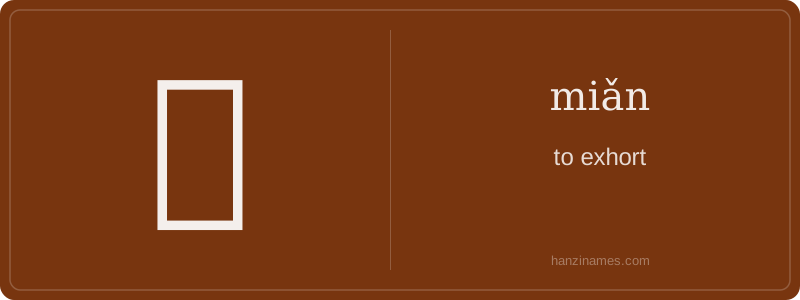
俛 is rare in modern spoken Mandarin but persists in classical texts, formal writing, and idioms like 俛首帖耳 (miǎn shǒu tiē ěr, 'to bow the head and press the ear' — meaning to submit obediently). It appears in historical records such as the *Book of Han*, where officials are described 俛勸 (miǎn quàn) — earnestly advising rulers. In contemporary usage, it survives mainly in literary allusions, academic discourse on Confucian ethics, and calligraphic practice.
The character is a phono-semantic compound: left 亻 (person radical) indicates human action; right 免 (miǎn) provides sound and semantic nuance — originally meaning 'to avoid' or 'to exempt', implying that exhortation helps others avoid missteps. No oracle-bone or bronze inscription evidence exists for 俛; it first appears in seal script during the Warring States period as a variant of 勉 (miǎn), sharing the same core meaning of 'to encourage earnestly'.
The character 俛 (miǎn) embodies a quiet, relational form of moral leadership in Chinese thought — not command, but earnest urging rooted in care and responsibility. Its radical 亻 (person) signals human agency, while the right side 免 (miǎn, 'to avoid') suggests that exhortation serves to help others avoid error or harm. This reflects Confucian ideals where virtue is cultivated through gentle guidance, not coercion — the sage exhorts not to dominate, but to uplift.
In classical Chinese ethics, 俛 implies humility-in-action: one who exhorts does so with lowered posture — literally bowing (the alternate reading fǔ reinforces this physical metaphor). The character thus fuses speech and stance: true encouragement arises from respectful presence, not authority alone. It mirrors the broader cultural emphasis on *ren* (benevolence) as active, embodied concern for others’ moral growth.
This worldview sees moral influence as subtle, persistent, and interpersonal — like water shaping stone. 俛 appears most often in literary or formal registers, never in casual speech, signaling its association with cultivated virtue and scholarly duty. Its rarity today underscores how deeply it’s tied to pre-modern literati ethics: exhortation as a solemn, face-to-face act of care — not feedback, not criticism, but compassionate, timely counsel offered in shared humanity.
Example Sentences
Common Compounds
Similar Characters — Don't Mix These Up
Your First Step into Chinese Culture: Get a Chinese Name
Every journey into Chinese begins with a name. Use our free Chinese name generator to create a meaningful, personalized Chinese name that fits you perfectly.
Get My Chinese Name →