俳
Character Story & Explanation
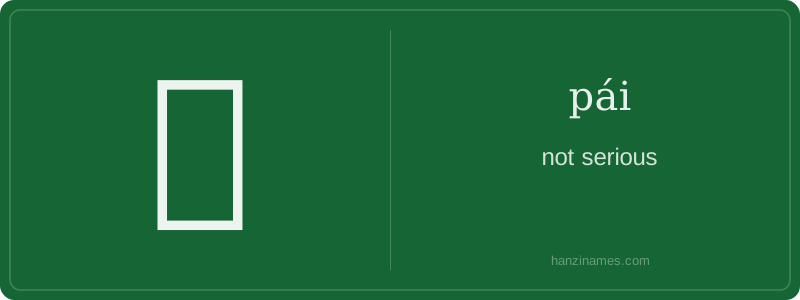
In modern Chinese, 俳 is virtually unused in daily life. It appears almost exclusively in academic or Sinological contexts—e.g., when discussing Japanese *haiku* (俳句, pái jù) or referencing Tang-Song literary criticism. The term 俳优 (pái yōu), meaning 'ancient court jester', is its most documented historical usage, recorded in texts like the *Book of Han*, where it denotes performers whose role was humorous or satirical—hence ‘not serious’. No common idioms contain 俳; it has no presence in HSK lists or modern textbooks.
The character’s structure is clearly phono-semantic: left radical 亻 (person) + right phonetic 非 (fēi, ‘not’). This reflects its original meaning—‘a person not [conforming to seriousness]’. Unlike pictographs, it shows no visual depiction of action or object; its origin is purely compositional, dating to the Warring States period script reforms—not earlier oracle bone forms.
As an archaeologist sifting through layers of linguistic sediment, I uncover 俳 not in oracle bones—but in Tang dynasty poetry manuscripts and Edo-period Japanese loan records. Its earliest attested use in Chinese texts is surprisingly rare; it appears mostly in classical critiques of light verse—poems dismissed as 'frivolous' or 'playful' compared to solemn shi poetry. The radical 亻 (person) signals human agency, while the phonetic component 非 (fēi, 'not') anchors its semantic core: a person who does *not* conform to serious literary orthodoxy.
This character’s journey reveals cultural friction: Chinese literati used 俳 pejoratively for jesting verse, yet Japanese scholars later embraced it—refining *haikai* (linked to 俳) into a revered art form. The irony is archaeological gold: a character meaning 'not serious' in Chinese became the root of Japan’s most disciplined poetic tradition. Its scarcity in pre-Ming Chinese corpora suggests it was marginal—used only by critics mocking unserious poets, never by the poets themselves.
Modern excavations of digital corpora confirm its near-absence in contemporary Mandarin speech and writing. It survives almost exclusively in scholarly Sino-Japanese contexts—e.g., discussing *haiku* history or citing classical literary theory. No native Mandarin speaker would say *pái shī* (‘comic poetry’) colloquially; instead, they’d say *xiào shī* or *yóu mò shī*. Thus, 俳 functions today like a fossilized lexical artifact: phonetically preserved, semantically intact, but functionally extinct in living Chinese—resurrected only for historical or cross-cultural precision.
Example Sentences
Common Compounds
Similar Characters — Don't Mix These Up
Your First Step into Chinese Culture: Get a Chinese Name
Every journey into Chinese begins with a name. Use our free Chinese name generator to create a meaningful, personalized Chinese name that fits you perfectly.
Get My Chinese Name →