洗
Character Story & Explanation
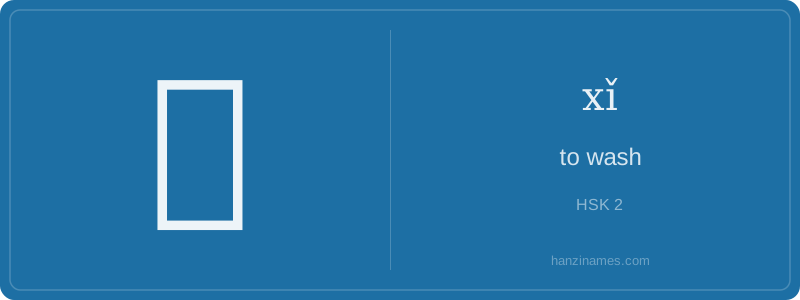
洗 is ubiquitous in modern Chinese life: it appears on signs (洗车店 'car wash shop'), product labels (洗发水 'shampoo'), and daily speech ('我先去洗个澡' — 'I’ll go take a shower first'). Historically, it appears in Tang dynasty texts like the *Tang Code*, where 洗涤 referred to ritual laundering of ceremonial robes. A well-known idiom is 洗心革面 (xǐ xīn gé miàn), meaning 'to reform completely', literally 'wash the heart and change the face', attested in Ming-era moral literature.
The character evolved from seal script (c. 3rd century BCE), where it combined 氵 (water) and 先 (xiān, 'first'—used phonetically). It was never a pictograph but a phono-semantic compound: the water radical conveys meaning; 先 provides approximate sound. No oracle bone form survives—its earliest confirmed appearance is in bronze inscriptions from the Warring States period, consistently denoting physical cleansing.
The Chinese character 洗 (xǐ) is a fundamental verb meaning 'to wash' or 'to bathe', and appears early in language learning—HSK Level 2—due to its high frequency in daily routines: washing hands, clothes, dishes, or oneself. Its left-side radical 氵 (three-dot water) immediately signals a water-related action, reinforcing semantic clarity for learners. Unlike English verbs that rely on context alone ('wash' can mean clean dishes or launder clothes), 洗 often requires a clear object or compound word (e.g., 洗澡, 洗衣服) to specify scope, reflecting Mandarin’s preference for explicit collocations.
In Chinese culture, washing carries layered significance beyond hygiene: ritual purification before ancestral worship, symbolic 'washing away' of bad luck during Spring Festival cleaning, and even metaphorical use in expressions like 洗脑 (xǐnǎo, 'brainwashing'). This contrasts with Western secular framing of washing as primarily functional—though Christian baptism or Jewish mikveh rituals do echo spiritual cleansing, they’re not lexicalized in everyday verbs the way 洗 is embedded in dozens of common compounds.
Western equivalents like 'wash' (English), 'laver' (French), or 'waschen' (German) lack the consistent radical-based transparency of 洗. While English relies on prefixes ('re-wash') or compounds ('dishwash'), 洗 naturally combines with nouns to form precise, productive compounds (e.g., 洗车 'car wash', 洗发 'shampoo'). This morphological regularity supports rapid vocabulary expansion—a key advantage for learners mastering HSK 2’s practical core lexicon.
Example Sentences
Common Compounds
Similar Characters — Don't Mix These Up
Your First Step into Chinese Culture: Get a Chinese Name
Every journey into Chinese begins with a name. Use our free Chinese name generator to create a meaningful, personalized Chinese name that fits you perfectly.
Get My Chinese Name →