俾
Character Story & Explanation
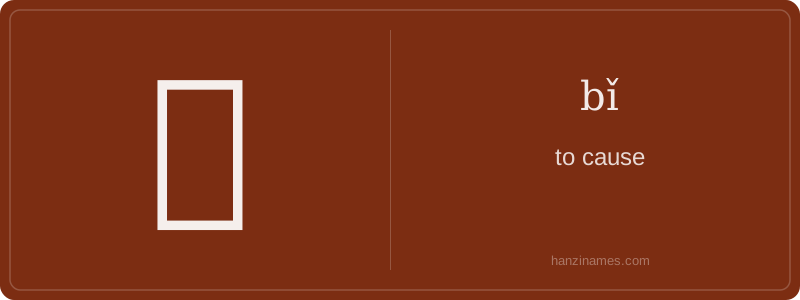
俾 appears regularly in modern Chinese legal and administrative language — especially in Hong Kong’s bilingual ordinances (e.g., Cap. 1 Laws of Hong Kong), where English ‘shall cause’ is translated as 俾…。It’s also found in fixed phrases like 俾有所成 (bǐ yǒu suǒ chéng, 'to enable success') and classical idioms preserved in formal speeches. Though rare in mainland colloquial use, it remains active in juridical and literary registers.
The character 俾 first appeared in bronze inscriptions of the Western Zhou dynasty (c. 1046–771 BCE) as a phonosemantic compound: 亻 (person/agent) + 比 (phonetic, bǐ). No pictographic origin — it was never a picture of an object. Its form stabilized by the Qin dynasty standardization and has remained unchanged for over 2,200 years.
Hi students! Today we’re learning the character 俾 (bǐ), a relatively formal and literary word meaning 'to cause' or 'to make (someone do something)'. It’s not common in everyday spoken Mandarin — you’ll hear it more in written texts, official documents, or classical-style expressions. Think of it like the English verb 'to render' or 'to cause to be': it introduces a result or effect, often with a sense of intention or authority.
This character belongs to the 亻 (rén) radical — the 'person' radical — which tells us it relates to human action or agency. Its right side, 比 (bǐ), originally meant 'to compare', but here it serves mainly as a phonetic component (giving the sound bǐ). Though simple in stroke count (10), 俾 carries weight — it implies causation with purpose, not just accidental influence.
Don’t confuse 俾 with more common causative verbs like 让 (ràng) or 使 (shǐ). While those appear in daily speech, 俾 is reserved for elevated or bureaucratic contexts — like legal clauses, academic writing, or historical translations. It’s also frequently seen in Hong Kong and Macau legal documents due to colonial-era bilingual drafting conventions, where English 'shall cause' or 'hereby causes' was rendered as 俾.
Example Sentences
Common Compounds
Similar Characters — Don't Mix These Up
Your First Step into Chinese Culture: Get a Chinese Name
Every journey into Chinese begins with a name. Use our free Chinese name generator to create a meaningful, personalized Chinese name that fits you perfectly.
Get My Chinese Name →