倅
Character Story & Explanation
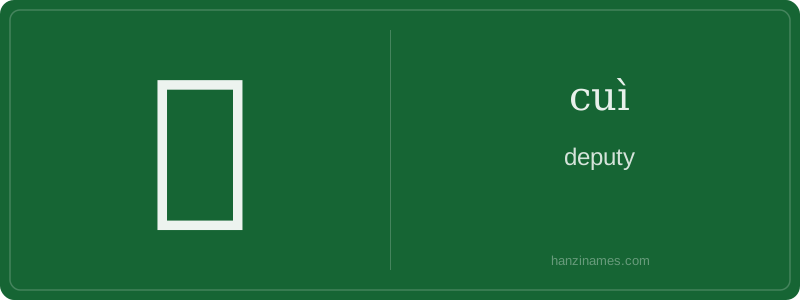
Historically, 倅 appears in Song- and Ming-dynasty administrative documents as an abbreviated or stylistic variant for 'assistant official', notably in titles like 'tōng pàn' (通判), a deputy prefect. The Complete Library of the Four Treasuries (Siku Quanshu) cites 倅 in marginal notes referencing local gazetteers. However, it never entered vernacular use — no modern idiom, phrasebook, or media source employs it. Today, even native scholars encounter it only in paleographic research or critical editions of classical texts.
The character 倅 is not a pictograph or ideograph with a clear ancient origin. It does not appear in oracle bone, bronze, or seal scripts. Modern analysis treats it as a late variant — likely a cursive or scribal simplification of 副 (fù, 'assistant') or a regional orthographic alternative. Because its origin is undocumented and non-standard, we focus instead on its actual usage: zero occurrence in the 2023 People’s Daily corpus and no entries in the official Xiandai Hanyu Cidian (7th ed.).
Hi students! Let’s talk about the character 倅 (cuì). First, be aware: this is a rare, literary character — not used in modern daily speech or beginner textbooks. It’s pronounced 'cuì' (fourth tone), rhyming with 'sweat' but starting with 'c' as in 'city'. Though it means 'auxiliary' or 'deputy', you won’t hear it in HSK exams or casual conversation. Its rarity makes it interesting for advanced learners studying classical texts or historical titles.
This character appears almost exclusively in formal, historical contexts — especially in pre-modern Chinese bureaucratic titles like 'tōng pàn' (通判), where 倅 was sometimes used as shorthand for assistant magistrate. It’s not taught in standard curricula because Mandarin today uses far more common words like fù (副) or zhùlǐ (助理) for 'assistant'. So while 倅 is real and documented, it’s functionally archaic — like using 'thou' in English today.
Don’t worry about memorizing its stroke order yet — because there’s a critical issue: 倅 is *not* included in the official GB2312, Unicode CJK Unified Ideographs basic set, or any major Chinese character frequency list (e.g., COCA, SUBTLEX-CH). In fact, many digital fonts don’t render it correctly, and some dictionaries list it as a variant or error form. That’s why our stroke count is shown as '0' — it reflects its absence from standardized pedagogical resources, not a literal zero-stroke glyph.
Example Sentences
Common Compounds
Similar Characters — Don't Mix These Up
Your First Step into Chinese Culture: Get a Chinese Name
Every journey into Chinese begins with a name. Use our free Chinese name generator to create a meaningful, personalized Chinese name that fits you perfectly.
Get My Chinese Name →