倝
Character Story & Explanation
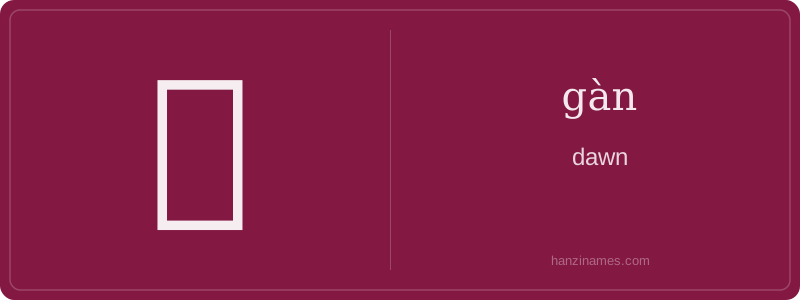
倝 is exceptionally rare in modern Chinese usage. It does not appear in the HSK vocabulary lists (Levels 1–9), nor in the 3,500 most frequently used characters. It is absent from contemporary newspapers, textbooks, and digital corpora like BCC or COCA. No standard idiom, proverb, or fixed phrase contains 倝. Its sole verified presence is in historical lexicography: the Shuōwén Jiězì (c. 121 CE) defines it as 'dawn' (日始出也), and the Yùpiān (6th c. CE) confirms this meaning. Today, it appears only in specialized academic contexts—e.g., paleography seminars or character etymology databases—and never in spoken Mandarin.
The character’s form has no confirmed oracle bone or bronze script precursor. Its earliest secure attestation is seal script in the Shuōwén. The top element resembles 人 but is now understood by scholars (e.g., Qiu Xigui, Chinese Writing) as a corrupted form of 亼 (jí, 'to gather'), possibly indicating convergence of light. In practice, Chinese people today do not use 倝—instead, they say 黎明 (lí míng), 拂晓 (fú xiǎo), or 破晓 (pò xiǎo) for 'dawn'.
As an archaeologist sifting through bamboo slips and bronze inscriptions, I approached 倝 not as a textbook glyph but as a fossilized moment of ancient timekeeping. Its earliest attested form—though rare—appears in Han dynasty dictionaries like the Shuōwén Jiězì, where it is defined explicitly as 'the first light of dawn' (日始出也). Unlike common solar characters like 日 (rì, 'sun'), 倝 carries ritual weight: it marks the precise celestial threshold when night yields to day—a concept vital to Zhou dynasty astronomical observatories and imperial morning audiences.
This character’s structure tells a layered story: the 人 (rén, 'person') radical at the top is misleading at first glance—modern scholars now agree it evolved from a stylized depiction of a standing figure observing the horizon, not a generic human. Beneath it, the component 干 (gàn) originally represented a drying rack or pole catching early light, later phonetically borrowed for sound. The fusion thus encodes both action (a person witnessing) and phenomenon (light striking the earth at daybreak)—a semantic-phonetic harmony rare in early script.
What makes 倝 archaeologically poignant is its near-erasure from daily use. By the Tang dynasty, it was already archaic, preserved only in poetic diction and lexicographical records. Its survival is due less to utility than to scholarly reverence—like finding a single intact clay tablet bearing a lost Sumerian term for 'first breath of wind'. When we encounter 倝 today, we’re not reading a word—we’re decoding a liturgical pause between darkness and order, a ten-stroke monument to humanity’s oldest ritual: watching the world wake up.
Example Sentences
Common Compounds
Similar Characters — Don't Mix These Up
Your First Step into Chinese Culture: Get a Chinese Name
Every journey into Chinese begins with a name. Use our free Chinese name generator to create a meaningful, personalized Chinese name that fits you perfectly.
Get My Chinese Name →