倥
Character Story & Explanation
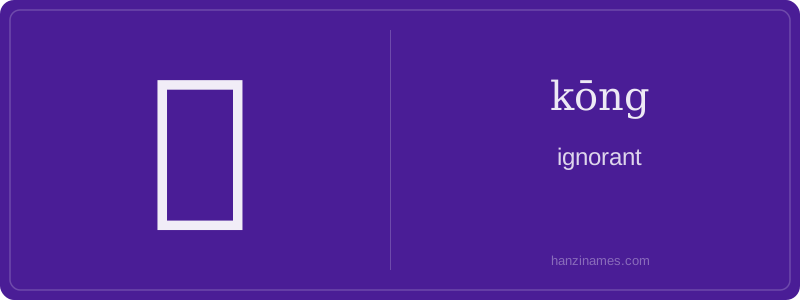
倥 is exceedingly rare in contemporary spoken Mandarin and does not appear in any HSK vocabulary list (HSK 1–9). It survives almost exclusively in classical texts and fixed literary expressions—most notably the idiom 倥偬 (kǒngzǒng), meaning 'hurried and flustered', where 倥 retains its archaic tone of disorientation and lack of composure. Historical usage appears in Tang and Song dynasty poetry and prose to describe chaotic, unsettled states of mind or circumstance.
The character’s form combines 亻 (person) and 空 (kōng, 'empty'), visually suggesting an 'empty person'—not literally vacant, but lacking substance: moral grounding, experience, or refinement. This semantic composition is well-documented in Shuōwén Jiězì (121 CE), which defines 倥 as 'ignorant, shallow, unsteady', confirming its ancient association with inner hollowness rather than mere lack of schooling.
The character 倥 (kōng/kǒng) embodies a nuanced Confucian ideal: ignorance is not merely absence of knowledge, but a morally significant state—often tied to immaturity, lack of cultivation, or unrefined character. In classical Chinese thought, true wisdom arises from self-awareness and humility; thus, being 倥 reflects a failure to engage in the lifelong moral and intellectual self-cultivation expected of a junzi (noble person). This contrasts sharply with Western notions of ignorance as neutral or temporary.
Its radical 亻 (person) signals that this ignorance is inherently relational and social—not just cognitive, but behavioral. A 倥 person may speak rashly, misjudge others, or act without propriety (lǐ), disrupting harmony. The character appears rarely in modern speech but persists in literary and philosophical discourse, where it carries quiet moral gravity—less about factual gaps than ethical underdevelopment.
This worldview reveals how Chinese ethics embed epistemology in virtue: knowing isn’t abstract—it’s inseparable from ritual awareness, emotional restraint, and social responsibility. To call someone 倥 is therefore a subtle yet serious judgment—not about IQ, but about whether one has internalized the humaneness (rén) and reverence (jìng) required to move through the world with grace and discernment.
Example Sentences
Common Compounds
Similar Characters — Don't Mix These Up
Your First Step into Chinese Culture: Get a Chinese Name
Every journey into Chinese begins with a name. Use our free Chinese name generator to create a meaningful, personalized Chinese name that fits you perfectly.
Get My Chinese Name →