倪
Character Story & Explanation
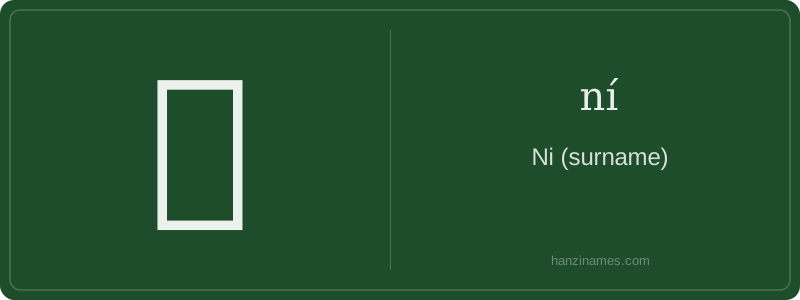
倪 is overwhelmingly used today as a Chinese surname — ranked #124 in the 2020 China Surname Report, borne by over 1.3 million people. It appears in historical records as early as the Song-era Bǎi Jiā Xìng, and notable bearers include Ni Zan (1301–1374), a revered Yuan dynasty painter and poet. Unlike common nouns, 倪 is rarely used standalone in modern speech; you won’t hear ‘倪’ meaning ‘child’ in classrooms or news broadcasts — that usage is confined to classical literature and academic commentary.
The character’s structure is clearly phono-semantic: 亻 (person radical) + 儿 (child, serving as both meaning hint and ancient phonetic component). While 儿 originally depicted a child in oracle bone script, 倪 itself has no verified pictographic origin — it emerged later as a compound character during the Warring States or early Han period, likely created to transcribe a clan name or regional title.
Our detective work begins with the radical: 亻, the 'person' radical — a silent witness to humanity in every character it anchors. In 倪, it signals this is a human-related term — not an object or abstract concept, but something tied to identity or social role. The right side, 儿 (ér), literally means 'child' and appears in characters like 兒 (traditional) and 兄 (older brother). Historically, 儿 was a pictograph of a kneeling child; here, it’s both phonetic (ní shares sound family with ér in ancient pronunciations) and semantic.
But wait — our suspect doesn’t mean ‘small child’ in modern standard usage. That definition is archaic and largely obsolete outside literary or historical texts. Modern dictionaries list 倪 primarily as a surname (e.g., the Ming-dynasty painter Ni Zan). The 'small child' meaning survives only in classical compounds like 倪子 (ní zǐ), used in pre-Qin and Han texts to denote infants or young dependents — a nuance lost in everyday speech today.
Our investigation reveals a classic case of semantic narrowing: a once-broad term for ‘young child’ fossilized into a proper noun. Like English ‘deer’, which once meant any animal but now names one species, 倪 shed its general meaning to become almost exclusively a family name. This evolution reflects how Chinese surnames often originated from titles, occupations, or even physical traits — though no definitive record confirms why 倪 became a surname, its earliest attestation is in the Hundred Family Surnames (Bǎi Jiā Xìng), compiled by the Song dynasty.
Example Sentences
Common Compounds
Similar Characters — Don't Mix These Up
Your First Step into Chinese Culture: Get a Chinese Name
Every journey into Chinese begins with a name. Use our free Chinese name generator to create a meaningful, personalized Chinese name that fits you perfectly.
Get My Chinese Name →