火
Character Story & Explanation
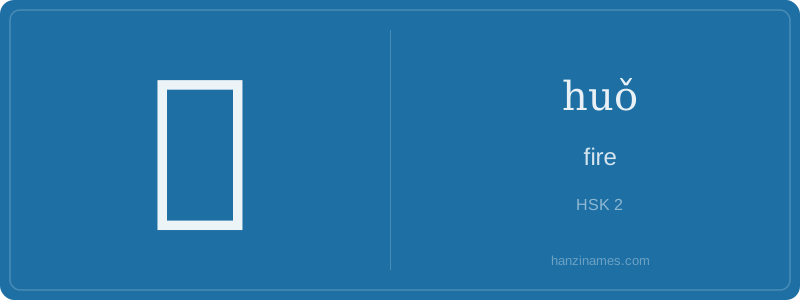
火 is ubiquitous in modern Chinese life—from kitchen signs (小心火烛, ‘Caution: Fire’) to digital slang (火了, ‘went viral’, lit. ‘caught fire’). It appears in official terminology like 火灾 (huǒzāi, ‘fire disaster’) and emergency services (消防, xiāofáng, ‘fire prevention’). Historically, oracle bone inscriptions (c. 1200 BCE) already depict 火 as a stylized flame—three upward strokes representing flickering flames and a dot or short stroke below for embers. Archaeological evidence confirms its early use in Shang dynasty divination records concerning ritual fires and harvest rites.
This character originated as a clear pictograph: three wavy or slanted strokes rising from a base point, mimicking flames leaping upward—a form preserved remarkably consistently across bronze script, seal script, and modern standard writing. No major structural evolution occurred, underscoring its visual intuitiveness and semantic stability.
The Chinese character 火 (huǒ) is a foundational pictograph representing 'fire'—one of the Five Elements (Wu Xing) in traditional Chinese philosophy, alongside wood, earth, metal, and water. Unlike Western elemental frameworks that often emphasize fire as destructive or purifying, Chinese cosmology views fire as dynamic, ascending, and associated with summer, the heart, joy, and southward direction. Its symbolic resonance extends into medicine, feng shui, and statecraft, where balance—not suppression—is key.
In contrast to Greco-Roman traditions (e.g., Prometheus’ stolen flame symbolizing rebellion and enlightenment), 火 carries less individualistic heroism and more collective resonance: fire sustains life (cooking, warmth), enables transformation (ceramics, metallurgy), and signals communal safety (beacon fires on the Great Wall). Even today, red lanterns and fireworks at Spring Festival evoke fire’s auspicious, yang-energy qualities—not chaos, but vibrant renewal.
Western religious imagery often casts fire as divine judgment (e.g., ‘lake of fire’ in Revelation) or trial (‘refiner’s fire’ in Malachi), whereas 火 in Chinese contexts rarely implies moral punishment. Instead, it appears in idioms like 火上浇油 (huǒ shàng jiāo yóu, ‘pouring oil on fire’) to warn against escalating conflict—not condemning anger itself, but urging mindful intervention. This reflects a broader cultural emphasis on harmony over binary morality.
Example Sentences
Common Compounds
Similar Characters — Don't Mix These Up
Your First Step into Chinese Culture: Get a Chinese Name
Every journey into Chinese begins with a name. Use our free Chinese name generator to create a meaningful, personalized Chinese name that fits you perfectly.
Get My Chinese Name →