倻
Character Story & Explanation
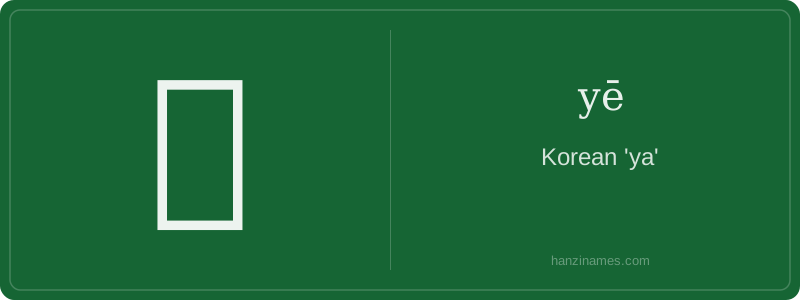
倻 is almost exclusively used in official Chinese-language documents, news reports, and academic publications to transcribe the Korean syllable 'ya' (e.g., in names like 여은 → 倻恩). It appears in Xinhua News Agency’s standardized Korean-name transliteration tables and is included in the 2013 *General Standard Chinese Character Table* (as a Level 3 character, for specialized use). It does not appear in idioms, classical texts, or everyday speech—no native Chinese word uses it, and it carries zero semantic content in Chinese.
The character has no ancient origin—it was newly coined in the late 20th century. Its form combines the 亻 (person) radical with 耶 (yē), a phonetic component historically used for transliteration (e.g., in 耶稣 yēsū for 'Jesus'). This follows the traditional Chinese practice of creating *fanqie*-style transliteration characters: selecting a phonetically close, existing character and adding a semantic radical (here, 亻) to signal ‘person-related’ usage, aligning with naming conventions.
The character 倻 (yē) is a linguistic bridge—not born from ancient Chinese philosophy or nature imagery, but crafted deliberately in modern times to transcribe the Korean syllable 'ya' (as in names like Kim Ye-jin or Lee Ye-seul). Its existence reflects China’s pragmatic engagement with neighboring languages: rather than forcing Korean names into existing Chinese phonetic approximations, linguists and standardization bodies created dedicated characters for accuracy and respect. This mirrors the Confucian value of *zhèngmíng* (rectification of names)—using precise terms to uphold social harmony and cultural dignity.
In the Chinese worldview, writing is not merely symbolic—it carries ethical weight. A correctly rendered foreign name signals sincerity and intercultural responsibility. 倻 embodies this ethos: though it has no independent meaning in Chinese, its very creation affirms that language must adapt ethically to global realities. It stands as quiet evidence that Chinese script remains a living, responsive system—not a fossilized relic, but a tool continually refined for mutual understanding across borders.
This character also reveals how Chinese orthography negotiates sovereignty and soft power. By assigning standardized characters to Korean names (per the 2013 *General Standard Chinese Character Table*), China participates in regional linguistic cooperation while maintaining scriptural autonomy. Unlike loanwords absorbed into English, 倻 isn’t borrowed—it’s *commissioned*. Its ten-stroke form, built on the human radical 亻, subtly affirms personhood: every name, even foreign ones, deserves a ‘human-shaped’ place in the written record—a small but profound act of recognition.
Example Sentences
Common Compounds
Similar Characters — Don't Mix These Up
Your First Step into Chinese Culture: Get a Chinese Name
Every journey into Chinese begins with a name. Use our free Chinese name generator to create a meaningful, personalized Chinese name that fits you perfectly.
Get My Chinese Name →