偝
Character Story & Explanation
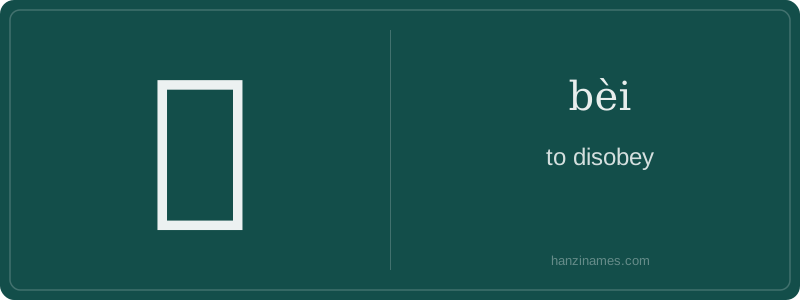
偝 (bèi) is extremely rare in modern spoken Mandarin and absent from all HSK levels (HSK 1–9). It appears almost exclusively in literary, historical, or legal contexts—most notably in idioms like 背信弃义 (bèixìn qìyì, 'to break faith and abandon righteousness') and 背道而驰 (bèidào érchí, 'to run counter to the right path'). Historical records show its use in Ming and Qing dynasty legal codes to denote betrayal of oaths or feudal obligations. Today, it survives primarily in formal writing, political rhetoric (e.g., condemning '背离初心'—bèilí chūxīn, 'deviating from one’s original aspirations'), and classical education.
The character’s structure combines the radical ⺈ (‘cover’ or ‘to cover over’) with the phonetic component 倍 (bèi, ‘times/multiple’). While not a pictograph, its composition suggests ‘covering over’ or ‘turning away from’—a conceptual origin well-documented in Shuōwén Jiězì (100 CE), China’s earliest dictionary, which defines 偝 as ‘to turn one’s back on; to oppose’. No oracle bone or bronze script forms survive, confirming its later, semantic derivation.
Imagine a quiet courtyard in Suzhou, where a young apprentice bows deeply before his master—a gesture of respect centuries old. But when the master instructs him to polish the antique inkstone *counterclockwise*, a subtle act of reverence for the stone’s spirit, the apprentice hesitates, then turns and polishes clockwise instead. That moment—turning away, resisting instruction not out of ignorance but willful divergence—is captured by 偝 (bèi). It’s not mere rebellion; it’s a deliberate, almost physical turning of the back on authority or tradition.
Unlike common words for ‘disobey’ like 违反 (wéifǎn) or 抗拒 (kàngjù), 偝 carries literary weight and moral gravity. In classical texts, it often describes filial disobedience—refusing ancestral rites or rejecting elders’ counsel—not as youthful defiance, but as a profound breach of cosmic and social order. Its rarity in speech reflects its seriousness: you’d rarely hear it in a schoolyard scolding, but you might find it in a judge’s verdict citing ‘背弃祖训’ (bèiqì zǔxùn, ‘abandoning ancestral teachings’).
This character appears most powerfully in fixed phrases and moral discourse. When Confucian scholars warn against ‘背道而驰’ (bèidào érchí, ‘running counter to the Way’), they invoke 偝 to signal ethical inversion—not just error, but active opposition to principle. Modern usage is largely restricted to formal writing, legal documents, or historical dramas, preserving its solemnity. Learners should recognize it not as a daily verb, but as a lexical marker of deep cultural consequence: turning one’s back isn’t just posture—it’s philosophy made visible.
Example Sentences
Common Compounds
Similar Characters — Don't Mix These Up
Your First Step into Chinese Culture: Get a Chinese Name
Every journey into Chinese begins with a name. Use our free Chinese name generator to create a meaningful, personalized Chinese name that fits you perfectly.
Get My Chinese Name →