偨
Character Story & Explanation
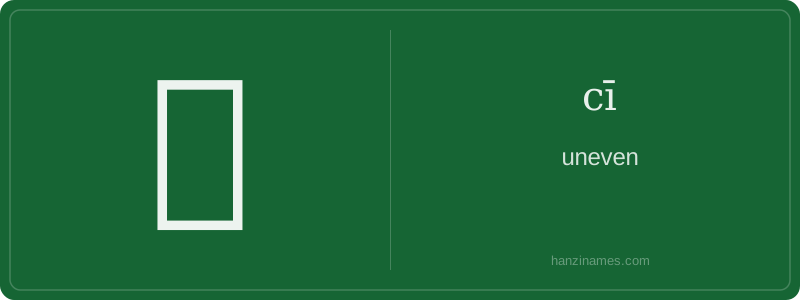
偨 is documented in ancient dictionaries like the Shuōwén Jiězì (121 CE), where it’s defined as 'not even; irregular' (不齊也), often used to describe uneven terrain, mismatched ranks, or asymmetrical arrangements in ritual contexts. Today, it survives almost exclusively in fixed literary phrases — for example, in classical-style poetry or scholarly annotations on traditional painting, where artists might describe brushwork as '偨歰' (cī sè), meaning 'jagged and halting'. You won’t hear it in conversation, but you may encounter it in museum captions or academic editions of Ming/Qing texts.
The character’s form has no verified pictographic origin. Unlike sun (日) or tree (木), 偨 evolved as a phono-semantic compound: 亻 (person, suggesting human-related imbalance) + 參 (cān, serving mainly as a phonetic hint for cī). In real life, modern Chinese speakers express 'uneven' using far more common terms like 不平 (bùpíng), 凹凸 (āotū), or 起伏 (qǐfú) — 偨 remains a quiet relic of classical precision.
Hi students! Let’s talk about the character 偨 (cī). It’s a relatively rare, classical character meaning 'uneven', 'irregular', or 'not level' — think of a bumpy road, mismatched heights, or inconsistent spacing. Though not common in modern daily speech, it appears in literary texts, poetic descriptions, and formal writing to convey subtle visual or conceptual imbalance. Don’t confuse it with more frequent synonyms like 不平 (bùpíng) — 偨 carries an elegant, almost tactile sense of asymmetry.
This character is rarely taught in beginner textbooks because it’s not part of the HSK syllabus at any level. In fact, it does not appear in the official HSK 1–6 word lists, nor is it included in the standard 3,500 most frequently used characters. Its usage is largely confined to historical documents, classical poetry, and specialized contexts like calligraphy critiques or architectural terminology describing irregular surfaces.
While 偨 looks simple, its structure is actually quite interesting: it combines the radical 亻 (person) on the left with 參 (cān, meaning 'to participate' or 'thrice') on the right — though this is a phonetic-semantic compound, not a literal pictograph. The pronunciation cī is shared with other characters like 刺 (cì, 'thorn'), but note the tone difference: 偨 is first tone, not fourth. Practice saying it clearly: “cī” — like 'see' but with a flat, high pitch.
Example Sentences
Common Compounds
Similar Characters — Don't Mix These Up
Your First Step into Chinese Culture: Get a Chinese Name
Every journey into Chinese begins with a name. Use our free Chinese name generator to create a meaningful, personalized Chinese name that fits you perfectly.
Get My Chinese Name →