傺
Character Story & Explanation
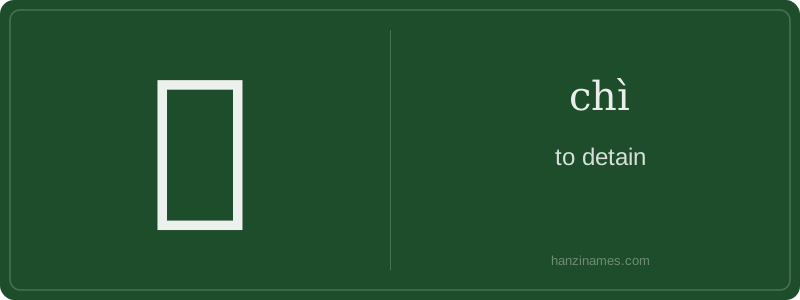
傺 is exceptionally rare in contemporary spoken Mandarin and does not appear in the HSK syllabus or modern vernacular dictionaries. It is absent from common idioms and has no documented usage in standard modern legal codes (e.g., the PRC Criminal Procedure Law uses 拘留 jūliú, 拘禁 jūjìn, or 扣押 kòuyā). Historically, 傺 appears only in pre-Qin and Han dynasty texts as a variant or archaic form related to ‘to detain’ or ‘to restrain’, but its usage is sparse and largely supplanted by more precise terms.
The character’s structure combines 亻 (person) and 少 (few), likely indicating minimal or provisional restraint. However, no authoritative paleographic source (e.g., Shuōwén Jiězì, oracle bone inscriptions, or bronze script corpora) confirms this as a pictographic or ideographic origin—it is best understood as a phonosemantic compound where 少 serves phonetically (chì shares sound family with 少 shǎo in Old Chinese reconstructions), not semantically. Today, it appears almost exclusively in scholarly editions of ancient texts or as a typographical variant.
The character 傺 (chì) embodies a subtle but profound aspect of traditional Chinese legal and social philosophy: the idea that detention is not merely punitive, but a calibrated act of authority—temporary, procedural, and embedded in hierarchical order. Its radical 亻 (person) paired with 少 (few, little) suggests restraint applied to an individual in measured, limited form—reflecting Confucian ideals of proportionality and ritual propriety (lǐ) even in coercion.
In classical governance, detention was rarely arbitrary; it served investigative or disciplinary functions within kinship- or community-based justice systems. 傺 thus conveys containment with intent—not eradication, but pause, reflection, or correction. This mirrors broader East Asian worldviews where boundaries (social, temporal, spatial) are held as necessary for harmony, not signs of failure.
Unlike Western binaries of freedom vs. imprisonment, 傺 implies relational accountability: one is detained *by* someone *for* something *within* a recognized framework. Its rarity in modern spoken Mandarin underscores how deeply such concepts were codified in written law and classical texts—not daily speech—but remain legible in legal terminology and historical discourse today.
Example Sentences
Common Compounds
Similar Characters — Don't Mix These Up
Your First Step into Chinese Culture: Get a Chinese Name
Every journey into Chinese begins with a name. Use our free Chinese name generator to create a meaningful, personalized Chinese name that fits you perfectly.
Get My Chinese Name →