僄
Character Story & Explanation
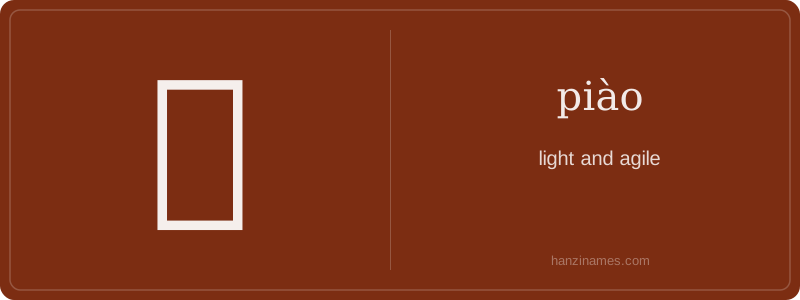
僄 (piào) is exceptionally rare in contemporary spoken Mandarin and does not appear in any HSK level. It occurs almost exclusively in classical texts, literary criticism, and poetic diction—particularly in phrases like '僄疾' (piào jí, 'agile and swift') or '僄轻' (piào qīng, 'light and sprightly'), found in Ming-Qing dynasty prose and Tang-Song poetry commentaries. The Complete Library of the Four Treasuries (Siku Quanshu) cites it in descriptions of dance movements and swordplay manuals emphasizing nimble footwork.
The character is a phono-semantic compound: the left radical 亻 (person) signals human agency; the right component 票 (piào) serves both phonetic and semantic reinforcement—originally meaning 'ticket' or 'certificate', but historically sharing the root sense of 'fluttering' or 'light movement' (cf. the older variant 票, related to 'flapping'). No oracle bone or bronze script forms survive; its earliest attestation is in Han dynasty bamboo slips, where it consistently modifies verbs of motion.
The character 僄 (piào) embodies a subtle yet profound facet of the Chinese worldview: lightness not as emptiness or insignificance, but as agile vitality—graceful motion, quick wit, and spirited ease. In Daoist and classical literary thought, 'lightness' (piào) often contrasts with heaviness (zhuó), symbolizing freedom from rigidity, spontaneity in action, and mental nimbleness. This reflects a deep cultural preference for fluid responsiveness over brute force or fixed form.
Unlike Western associations of 'light' primarily with illumination or weightlessness, 僄 evokes *kinetic elegance*—the dancer’s leap, the poet’s swift turn of phrase, the strategist’s agile adaptation. Its connotation is aesthetic and ethical: to be 僄 is to move through life with unburdened clarity and refined alertness, never careless, always poised. This aligns with Confucian ideals of *yì* (righteous ease) and Zhuangzi’s celebration of effortless action (*zìrán*).
In modern usage, 僄 remains rare in daily speech but resonates powerfully in literary and artistic discourse—especially when describing calligraphic brushstrokes, martial arts footwork, or lyrical rhythm. Its rarity enhances its cultural weight: it appears not in bureaucratic documents or textbooks, but in poetry anthologies, opera critiques, and classical painting inscriptions. To encounter 僄 is to glimpse a refined, almost ceremonial appreciation for grace under precision—a quiet testament to how Chinese aesthetics infuses moral and physical qualities into single characters.
Example Sentences
Common Compounds
Similar Characters — Don't Mix These Up
Your First Step into Chinese Culture: Get a Chinese Name
Every journey into Chinese begins with a name. Use our free Chinese name generator to create a meaningful, personalized Chinese name that fits you perfectly.
Get My Chinese Name →