佥
Character Story & Explanation
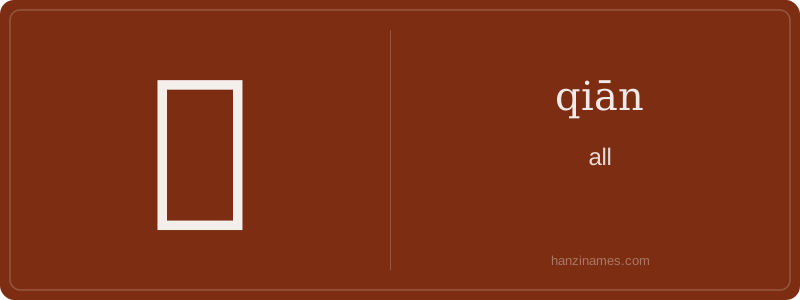
Today, 佥 appears almost exclusively in formal, historical, or literary contexts—not in daily speech. It survives in classical idioms like 佥曰可 (qiān yuē kě, 'all say yes'), used in political rhetoric to evoke unanimous approval, and in fixed terms such as 佥名 (qiān míng, 'to co-sign'). Modern legal documents rarely use it; instead, 全体 (quántǐ, 'entire group') or 共同 (gòngtóng, 'jointly') have replaced it. Its presence signals archaic register or deliberate stylistic gravitas.
The character’s origin is documented in seal script (zhuànshū): it evolved from a triple-person glyph (three 人 stacked or mirrored), later simplified to the current form with two 人 radicals and three horizontal strokes above—symbolizing unity of multiple parties. This structure is confirmed in the Shuōwén Jiězì (100 CE), which defines it as 'all people agreeing'.
As an archaeologist brushing dust from a Song dynasty legal manuscript, I found 佥 scrawled in ink beside dozens of official seals—its seven strokes a compact signature of collective assent. Unlike pictographic ancestors carved in oracle bone, 佥 emerged in clerical script as a stylized fusion: the radical 人 (person) doubled and tripled into a symmetrical glyph representing 'all people'—not just individuals, but consensus made visible. Its form whispers bureaucratic ritual: no decree stood unless every relevant party had ‘signed’ with this character.
This character is not a relic—it’s a living fossil. In Ming legal codes, 佥 denoted compulsory conscription or corvée labor assigned to *all* households in a village—a binding, communal obligation. The stroke order (starting with the left 人, then right, then the three horizontal strokes above) mirrors its semantic logic: first the agents, then their unified action. Even today, its shape retains that ancient weight: not mere plurality, but mandated, institutionalized totality.
What makes 佥 extraordinary is its functional duality: it functions both as a verb ('to sign collectively') and as an adverbial prefix meaning 'all' or 'jointly'. This reflects early Chinese administrative pragmatism—language shaped by the need to record mass participation without redundancy. No extra characters were wasted; 佥 alone carried the force of unanimity. When excavating Tang-era tax ledgers, I’ve seen 佥 paired with terms like 佥差 (qiān chāi, 'jointly assigned duty'), proving its role as the grammatical keystone of premodern collective responsibility.
Example Sentences
Common Compounds
Similar Characters — Don't Mix These Up
Your First Step into Chinese Culture: Get a Chinese Name
Every journey into Chinese begins with a name. Use our free Chinese name generator to create a meaningful, personalized Chinese name that fits you perfectly.
Get My Chinese Name →