僔
Character Story & Explanation
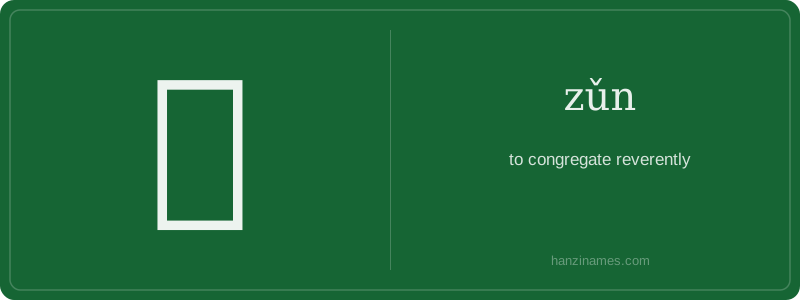
僔 is virtually absent from modern spoken or written Mandarin outside specialized academic, literary, or ritual contexts. It appears in classical texts like the *Lǐjì* (e.g., '僔于宗廟' — 'congregated at the ancestral temple') and the *Shuōwén Jiězì* (121 CE), which defines it as 'gathering respectfully' (敬聚也). No common idioms or modern compounds include it; it is not in the HSK, GB2312, or modern frequency lists.
The character’s form combines the radical 亻(person) with 尊 (zūn, 'to revere'), indicating a person acting with reverence—hence, congregating with solemn intent. This structural logic is documented in *Shuōwén*, not invented. In practice today, you might encounter 僔 in a museum exhibit label about Zhou dynasty bronze inscriptions or in a scholar’s annotated translation of early Confucian liturgy.
The character 僔 (zǔn) is a rare, classical Chinese character meaning 'to congregate' or 'to gather together in reverence'. It appears almost exclusively in pre-Qin and Han dynasty texts—especially in ritual and philosophical contexts—where it describes the solemn assembly of nobles, ministers, or sages before ancestral altars or during state ceremonies. Its usage reflects Confucian ideals of hierarchical harmony and collective respect.
Unlike common modern verbs like jùjí (聚集) or huìjí (汇集), 僔 carries an archaic, ceremonial weight. You won’t hear it in daily conversation or see it on street signs—but it endures in scholarly editions of the *Book of Rites* (*Lǐjì*) and *Zuo Zhuan*, where it denotes intentional, dignified gathering—not mere physical proximity, but moral and ritual alignment.
This character exemplifies how classical Chinese encodes nuanced social action through single glyphs. Its rarity today makes it a linguistic artifact: studied by sinologists, cited in academic papers on Zhou dynasty rites, and occasionally revived in calligraphy or cultural branding for heritage projects. Learning 僔 opens a window not just to vocabulary, but to ancient Chinese political cosmology—where gathering was sacred geometry made human.
Example Sentences
Common Compounds
Similar Characters — Don't Mix These Up
Your First Step into Chinese Culture: Get a Chinese Name
Every journey into Chinese begins with a name. Use our free Chinese name generator to create a meaningful, personalized Chinese name that fits you perfectly.
Get My Chinese Name →