僜
Character Story & Explanation
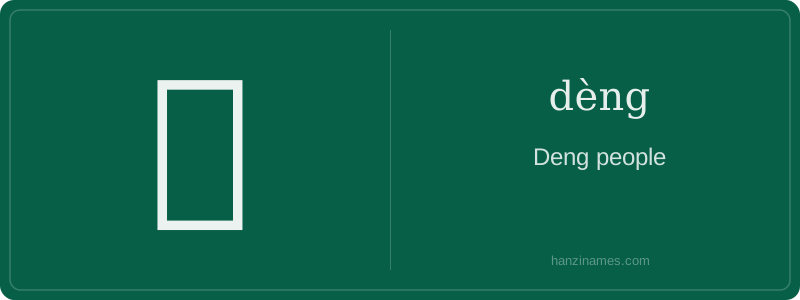
僜 is almost exclusively used in official, academic, and journalistic contexts referring to the Deng people—e.g., government white papers on ethnic policies, CCTV documentaries on Tibetan minorities, or ethnographic studies published by the Chinese Academy of Social Sciences. It appears in compound terms like 僜人 (Dèng rén, 'Deng people') and 僜语 (Dèng yǔ, 'Deng language'), but never in idioms, poetry, or daily conversation. There are no common phrases or historical literary usages before the 1980s.
The character has no ancient origin—it was newly constructed in the late 20th century using the 亻 (person) radical + 登 (dēng, 'to ascend'). This reflects its geographic reality: the Deng live in steep, high-elevation valleys of southeastern Tibet. The choice of 登 evokes both phonetic approximation (dèng ≈ dēng) and symbolic resonance ('ascending' terrain), making it a deliberate, top-down orthographic act grounded in real geography and policy need.
The character 僜 (dèng) is a rare, modern coinage—not found in classical texts—created specifically to denote the Deng people, an officially recognized ethnic group residing in Tibet’s remote Upper Lohit Valley, near the India-China border. Its existence reflects China’s linguistic and administrative commitment to ethnonational recognition: when minority groups lack traditional Han-script representation, new characters are formally standardized. This act embodies the Chinese worldview that language is not static but a living tool of inclusion, identity, and state-led cultural documentation.
Unlike ancient characters rooted in oracle bones or bronze inscriptions, 僜 carries no millennia-old symbolism—it emerged from 20th-century ethnographic work and was codified in the 1993 GB18030 character set. Its creation signals how contemporary China integrates frontier communities into national discourse through script itself. The character thus functions less as a semantic unit and more as a sociopolitical marker—proof that writing can be purpose-built for dignity, visibility, and bureaucratic precision in multicultural governance.
This character invites reflection on how writing systems evolve alongside nation-building. In China’s framework, naming is foundational to belonging: to have a unique, standardized character is to be legible within law, education, and census systems. 僜 does not mean 'good' or 'light'—it means 'we see you'. It represents the quiet power of orthography in affirming identity, especially for small, high-altitude communities whose oral traditions long predated written representation. Here, language becomes cartography: mapping people onto the national script.
Example Sentences
Common Compounds
Similar Characters — Don't Mix These Up
Your First Step into Chinese Culture: Get a Chinese Name
Every journey into Chinese begins with a name. Use our free Chinese name generator to create a meaningful, personalized Chinese name that fits you perfectly.
Get My Chinese Name →