偾
Character Story & Explanation
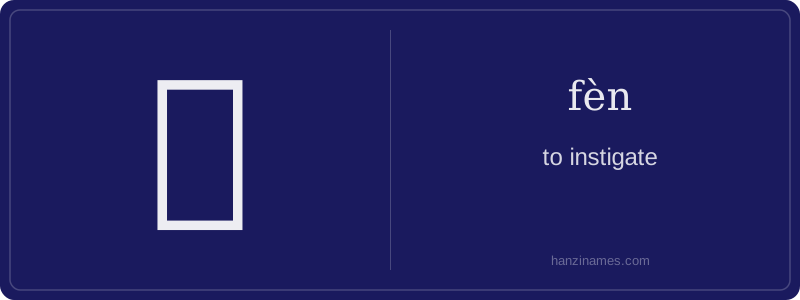
偾 appears primarily in classical idioms and formal writing—not daily speech. Its most documented usage is in the idiom 偾事增光 (fèn shì zēng guāng), meaning 'to sabotage an undertaking while claiming credit', cited in Qing-dynasty administrative critiques and modern political discourse analyzing bureaucratic hypocrisy. It also occurs in historical records describing rebellions 'instigated by corrupt officials' (如:奸臣偾乱). Modern media use it sparingly, usually in editorials condemning inflammatory rhetoric.
The character is not pictographic; it’s a phono-semantic compound. The left side 亻 denotes 'person'; the right side 喷 (pēn) provides sound and reinforces the idea of forceful emission—like inciting words erupting from a speaker. No oracle-bone or bronze script forms survive; earliest attestation is in Han dynasty texts. Today, Chinese learners encounter it mainly in HSK-advanced reading passages or classical literature courses—not in conversation.
偾 (fèn) is a classical Chinese character rarely used in modern spoken Mandarin but preserved in literary and formal contexts. Its core meaning—'to instigate', 'to provoke', or 'to incite'—carries a strong connotation of stirring up action, often with negative or disruptive undertones. It appears almost exclusively in set phrases and historical texts, not in daily conversation. Learners won’t hear it on the subway or in street markets—but they might encounter it in editorial commentary or classical poetry analysis.
The character’s radical 亻 (person) signals human agency, while the phonetic component 喷 (pēn, 'to spurt') hints at forceful emission—like words bursting forth to trigger change. This semantic-phonetic structure reflects ancient Chinese lexicographic logic: action originates from people and manifests explosively. Though visually simple (11 strokes), its usage demands cultural literacy—not just vocabulary recall.
Because 偾 is functionally obsolete in colloquial speech, mistaking it for similar-sounding characters like 奋 (fèn, 'to exert oneself') is common. Yet its precision remains unmatched in contexts demanding rhetorical gravity—e.g., describing how a speech 'instigates unrest' or how propaganda 'provokes factionalism'. Mastery signals advanced reading competence, especially in pre-modern or politically nuanced texts.
Example Sentences
Common Compounds
Similar Characters — Don't Mix These Up
Your First Step into Chinese Culture: Get a Chinese Name
Every journey into Chinese begins with a name. Use our free Chinese name generator to create a meaningful, personalized Chinese name that fits you perfectly.
Get My Chinese Name →