僰
Character Story & Explanation
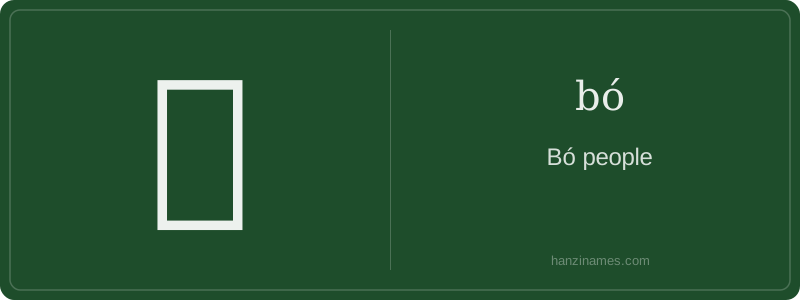
僰 (bó) appears almost exclusively in historical and archaeological contexts — notably in references to the ‘Bó people’ (僰人), an ancient ethnic group centered in present-day southern Sichuan and northern Yunnan. Documented in Sima Qian’s Records of the Grand Historian (c. 94 BCE) and later in Tang-Song gazetteers, they were noted for cliff burials and resistance to Han expansion. Today, the character surfaces in academic publications, museum exhibits (e.g., at the Yibin Museum), and official cultural heritage listings — never in daily conversation or media.
The character’s structure combines 亻 (person radical) and 棘 (jí, ‘thornbush’), used here solely for phonetic value (both *bó* and *jí* shared historical rime-group affinities in Middle Chinese). No pictographic origin exists — it was invented as a phonosemantic compound for an ethnonym, with no earlier oracle bone or bronze inscriptions verified.
The character 僰 (bó) is a rare, historically loaded term referring to the ancient Bó people — a non-Han ethnic group documented in southwestern China from the Warring States to the Han dynasty. Unlike common characters with rich semantic evolution, 僴 appears almost exclusively in classical texts and archaeological reports. Its scarcity means it has no modern phonetic or semantic derivatives; it survives only as a lexical fossil, preserved in historiography rather than daily speech.
Linguistically, 僰 belongs to the ‘person’ radical category (亻), yet its left component ‘棘’ (jí, thornbush) is purely phonetic — not semantic. This reflects an ancient borrowing strategy: using a complex, visually distinctive sound-sign to fix pronunciation for an exonym. No oracle bone or bronze script forms are attested, confirming its late appearance — likely standardized during Han lexicographic efforts like the Shuōwén Jiězì.
Modern usage of 僰 is strictly academic or commemorative: seen in museum labels, regional histories of Yunnan/Sichuan, and UNESCO-related heritage discussions about the ‘Bó cliff tombs’. It carries no colloquial valence — no slang, no internet variants, no homophone puns. Its silence in spoken Mandarin (often mispronounced or avoided altogether) underscores how deeply some characters are anchored in textual memory rather than living language.
Example Sentences
Common Compounds
Similar Characters — Don't Mix These Up
Your First Step into Chinese Culture: Get a Chinese Name
Every journey into Chinese begins with a name. Use our free Chinese name generator to create a meaningful, personalized Chinese name that fits you perfectly.
Get My Chinese Name →