儃
Character Story & Explanation
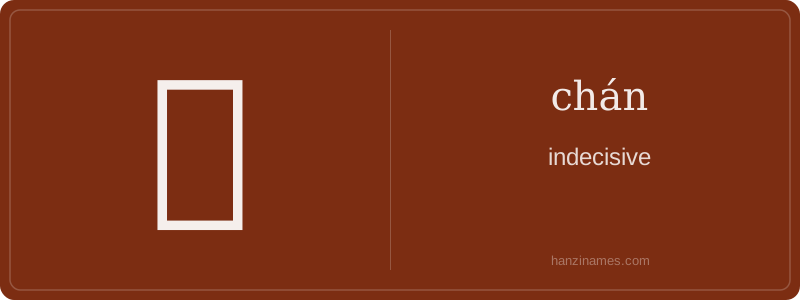
儃 (chán) is virtually absent from modern spoken and written Chinese. It appears only in classical literature—most notably in the *Huainanzi* (2nd c. BCE) and occasional Tang-Song poetic commentary—to describe hesitant, faltering resolve. No idioms (chengyu) contain it; it does not appear in any HSK vocabulary list, dictionary frequency rankings, or contemporary media. Its usage is strictly historical and literary, confined to scholarly editions of pre-modern texts.
The character’s form combines the human radical (亻) with the phonetic component 單 (dān, 'single'). While 單 originally depicted a hunting net (in oracle bone script), its use here is purely phonetic—not semantic. There is no pictographic representation of 'indecisiveness'; the meaning arises solely from textual context and phonetic association. In practice today, Chinese speakers use 懊恼 (àonǎo), 犹豫 (yóuyù), or 举棋不定 (jǔqíbùdìng) instead.
As an archaeologist sifting through layers of linguistic sediment, I find 儃 (chán) not in oracle bones or bronze inscriptions—but in the quiet erosion of classical texts. It surfaces rarely, like a weathered stone half-buried in Han dynasty philosophical debates: not a core concept, but a subtle diagnostic marker for mental hesitation—where willpower frays at the edges. Its scarcity suggests it was never a tool of daily speech, but a precision scalpel for diagnosing inner conflict in moral psychology.
This character resists simplification. Unlike common radicals that anchor meaning (e.g., 心 for heart/mind), 儃’s structure offers no pictorial clue—no ‘person’ walking uncertainly, no ‘mouth’ stammering. Instead, its left side (亻) signals human agency; its right (單) is a phonetic component borrowed from the word for ‘single’ or ‘sole’, hinting at isolation in decision-making. Thus, indecisiveness here isn’t vacillation—it’s the paralysis of standing alone before a choice with no external guide.
Modern excavations reveal 儃 has vanished from spoken Mandarin and most written registers. It survives only in pre-20th-century literary criticism and rare classical citations—like a fossilized neuron in a brain scan of ancient Chinese thought. Its absence speaks volumes: when Confucian and Daoist traditions emphasized decisive virtue or effortless action (wu wei), lingering doubt needed naming only in edge cases. Today, encountering 儃 feels like unearthing a single, exquisitely carved ivory seal—beautiful, functional once, now purely archival.
Example Sentences
Common Compounds
Similar Characters — Don't Mix These Up
Your First Step into Chinese Culture: Get a Chinese Name
Every journey into Chinese begins with a name. Use our free Chinese name generator to create a meaningful, personalized Chinese name that fits you perfectly.
Get My Chinese Name →