儩
Character Story & Explanation
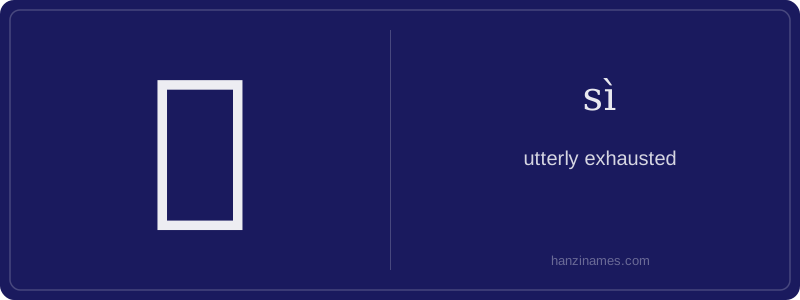
儩 appears in classical Chinese texts such as the Shuōwén Jiězì (121 CE), defined as '尽也' (jìn yě)—'to exhaust completely'. It survives in fixed literary phrases like '用儩' (yòng sì, 'to use up entirely') and '耗儩' (hào sì, 'to deplete utterly'), notably in Qing-dynasty essays on fiscal policy and late-imperial agricultural treatises warning against over-cultivation. Modern usage is restricted to academic writing, historical novels, and environmental journalism emphasizing irreversible loss.
The character is composed of the radical 亻 (rén, 'person') and the phonetic component 賜 (cì, 'to bestow'). Its structure reflects the conceptual link between human agency and exhaustion: what is bestowed may also be spent. Though not pictographic, its form signals that depletion is an act involving people—not abstract fate, but consequence of action or inaction.
儩 (sì) is a rare, literary Chinese character meaning 'the end', 'exhaustion', or 'complete depletion'—not merely chronological conclusion, but the final, irreversible cessation of something vital: resources, energy, time, or life itself. It carries solemn, almost elegiac weight, appearing mostly in classical texts, poetry, and formal registers. Unlike common words for 'end' like 结束 (jiéshù) or 终止 (zhōngzhǐ), 儩 implies totality and irrevocability—like the last drop of water in a cracked well.
This character evokes profound cultural sensibilities about finitude and stewardship. In traditional agrarian society, where scarcity was ever-present, phrases using 儩 reflected deep awareness of limits—whether grain stores, ancestral virtue, or human vitality. Its rarity today underscores how modern Mandarin favors more accessible synonyms, yet 儩 persists in literary criticism, historical documents, and idiomatic expressions tied to moral or existential exhaustion.
Though absent from daily spoken Chinese, 儩 surfaces in educated discourse on sustainability, heritage preservation, or ecological collapse—e.g., '文化资源几近用儩' ('cultural resources are nearly exhausted'). Its resonance lies not in frequency, but in precision: it names not just an ending, but the moment after which nothing remains to draw upon. This semantic gravity makes it a quiet anchor in China’s lexical archive of impermanence.
Example Sentences
Common Compounds
Similar Characters — Don't Mix These Up
Your First Step into Chinese Culture: Get a Chinese Name
Every journey into Chinese begins with a name. Use our free Chinese name generator to create a meaningful, personalized Chinese name that fits you perfectly.
Get My Chinese Name →