儳
Character Story & Explanation
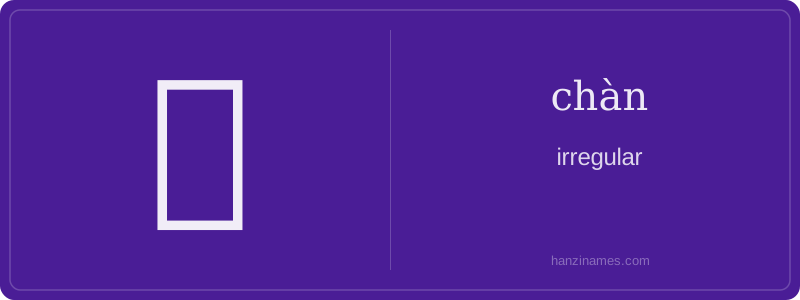
儳 is virtually absent from modern spoken Mandarin and everyday writing. It appears in historical texts such as the Zuo Zhuan (c. 4th century BCE), where it describes irregular troop formations or morally inconsistent conduct among feudal lords. The Shuowen Jiezi (121 CE), China’s earliest dictionary, defines it as 'not aligned; uneven in rank or position' (不齊也), confirming its classical bureaucratic and military usage. Today, it survives only in scholarly editions, classical poetry anthologies, or as a component in rare compound words.
The character’s form combines the radical 亻 (person) with the phonetic element 毚 (chǎn), originally depicting a hare fleeing—suggesting evasion or deviation. This phonetic component also appears in characters like 警 (jǐng, 'to warn') and 選 (xuǎn, 'to select'), sharing the root idea of discernment amid variation. No oracle-bone or bronze script forms are attested for 儳; it emerged later in seal script as a specialized term for normative deviation.
The Chinese character 儳 (chàn) is a rare, literary term meaning 'irregular', 'uneven', or 'disorderly'—often describing spatial arrangement, rhythm, or moral inconsistency. Unlike common synonyms like 不规则 (bù guīzé), 儳 carries classical weight and appears almost exclusively in pre-modern texts, historical records, or highly stylized modern writing. Its usage evokes a sense of archaic precision, akin to English words like 'askew' or 'heteroclite'—technically accurate but seldom heard in daily speech.
Western equivalents include the Greek-derived 'anomalous' or Latin 'irregularis', both emphasizing deviation from normative structure. In legal or architectural contexts, 'asymmetrical' or 'unbalanced' may overlap semantically—but 儳 implies not just visual imbalance, but a deeper ontological or ethical irregularity, reminiscent of Confucian concerns about ritual propriety (礼, lǐ) and harmonious order. It’s less about aesthetics and more about normative alignment.
This character reflects a core Chinese philosophical value: harmony through regularity. Its rarity today underscores how deeply embedded standardization is in Chinese cultural practice—from calligraphy grids to civil service exams. While English tolerates casual irregularity ('off-kilter', 'wonky'), 儳 conveys mild censure, as if the irregularity violates an implicit cosmic or social contract. Learning it offers insight into classical Chinese attitudes toward structure, discipline, and the moral weight of form.
Example Sentences
Common Compounds
Similar Characters — Don't Mix These Up
Your First Step into Chinese Culture: Get a Chinese Name
Every journey into Chinese begins with a name. Use our free Chinese name generator to create a meaningful, personalized Chinese name that fits you perfectly.
Get My Chinese Name →