傩
Character Story & Explanation
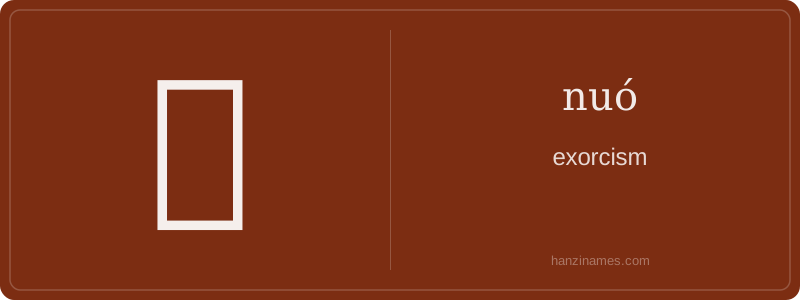
傩 is rarely used in daily modern speech but remains vital in cultural documentation, academic writing on folk religion, and official preservation efforts. It appears in terms like 傩戏 (nuóxì, Nuó opera) — a living tradition performed by hereditary troupes in southern China, with verified records dating to the Tang Dynasty (618–907 CE). The State Council listed ‘Jiangxi Nanchang Nuó Opera’ as National Intangible Cultural Heritage in 2006.
The character’s written form has no confirmed pictographic origin. Unlike sun (日) or tree (木), 傩 lacks early pictorial variants. Instead, it first appears in Warring States bamboo slips (475–221 BCE) as a phonosemantic compound: 亻 (human agent) + 難 (sound carrier, nán → nuó). Today, Chinese people encounter it mainly in museum exhibits, heritage documentaries, or university courses on Chinese ritual theatre.
Our detective begins at the crime scene: the character 傩 (nuó). At first glance, it’s a man (亻) paired with a mysterious right-hand component (難). But this isn’t just any man — he’s a ritual specialist. The radical 亻 signals human agency, while the phonetic-semantic compound 難 (nán, 'difficult; hardship') hints at the arduous, sacred labor of confronting spiritual danger. Early inscriptions show no oracle-bone or bronze forms — 傩 emerges fully formed in Warring States bamboo texts, already tied to exorcism.
Zooming in on the right side: 難 originally depicted a bird (隹) under a roof (宀), later reanalyzed as ‘hardship’ — but in 傩, it serves primarily as a *sound hint* (nán → nuó via historical sound shift), not meaning. Linguists confirm that nuó is a *specialized ritual term*, preserved only in ceremonial vocabulary — not a general word for ‘drive away’. Its survival is linguistic archaeology: a fossilized verb from ancient state-sponsored rites.
This character doesn’t live in textbooks — it lives in mountains and masked faces. In Jiangxi, Guizhou, and Hunan, Nuó opera troupes still perform *Nuó xiè* (exorcism dramas) during Lunar New Year and harvest festivals. Every gesture, mask, and chant follows lineages over 2,000 years old. UNESCO recognized ‘Chinese Nuó culture’ as intangible heritage in 2006 — not as folklore, but as continuous, documented practice. 傩 is less a word than a portal: one stroke away from history, one syllable away from spirit-world protocol.
Example Sentences
Common Compounds
Similar Characters — Don't Mix These Up
Your First Step into Chinese Culture: Get a Chinese Name
Every journey into Chinese begins with a name. Use our free Chinese name generator to create a meaningful, personalized Chinese name that fits you perfectly.
Get My Chinese Name →