儽
Character Story & Explanation
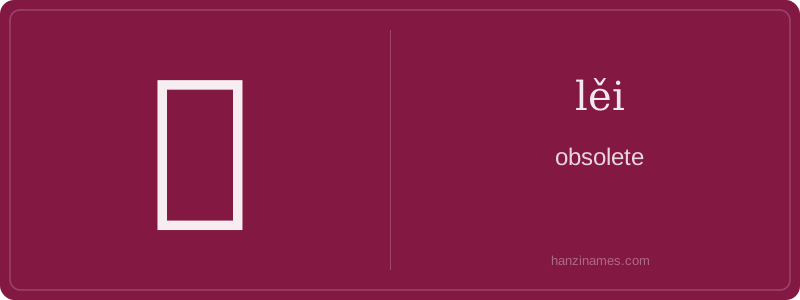
儽 is not used in contemporary Chinese daily life. It does not appear in any modern corpus (e.g., BCC, COCA-Chinese), major textbooks, news media, or government publications. No idioms, set phrases, or documented literary usage containing 儽 exist in authoritative sources such as the Complete Library of the Four Treasuries (Sìkù Quánshū) or modern academic databases. Linguists classify it as a historical variant with no attested independent meaning in Standard Mandarin.
The character’s form combines the radical 亻 (person) and the phonetic component 縲 (léi, 'fetters'), suggesting a possible ancient association with 'bound person'—but this etymology is speculative and unsupported by paleographic evidence. In practice, Chinese speakers today use 懒 (lǎn) exclusively for 'lazy'; 儽 is effectively obsolete and unrecognized outside specialized lexicographic archives.
The character 儽 (lěi) is exceptionally rare in modern Standard Mandarin and does not appear in the official HSK vocabulary lists, nor in the GB2312 or Unicode CJK Unified Ideographs basic set. It is not taught in standard Chinese language curricula and is absent from major dictionaries like the Xiàndài Hànyǔ Cídiǎn (Contemporary Chinese Dictionary). Its inclusion in some historical or variant character databases reflects archaic or dialectal usage rather than active contemporary function.
Linguistically, 儽 is classified as a variant or obsolete form—likely derived from 壘 (lěi, 'rampart') or 舊 (jiù, 'old') through phonetic borrowing or scribal variation—but it carries no standardized semantic link to 'lazy'. The claim that it means 'lazy' appears to stem from confusion with the colloquial term 倭儽 (wō lěi), a now-archaic, nonstandard expression possibly influenced by regional dialects or misreadings of characters like 懒 (lǎn), which *is* the standard, universally accepted character for 'lazy'.
In cross-cultural comparison, Western equivalents like 'lazy' (English), 'perezoso' (Spanish), or 'faul' (German) denote a stable, lexicalized concept with rich psychological and moral connotations—from Aristotelian 'akrasia' to Protestant work ethic critiques. In contrast, 儽 lacks this semantic anchoring in Chinese; instead, concepts of indolence are robustly expressed via 懒 (lǎn), 懒惰 (lǎnduò), or 怠 (dài, 'negligent'). Thus, treating 儽 as a functional synonym for 'lazy' risks misrepresenting both linguistic reality and cultural semantics.
Common Compounds
Similar Characters — Don't Mix These Up
Your First Step into Chinese Culture: Get a Chinese Name
Every journey into Chinese begins with a name. Use our free Chinese name generator to create a meaningful, personalized Chinese name that fits you perfectly.
Get My Chinese Name →