冀
Character Story & Explanation
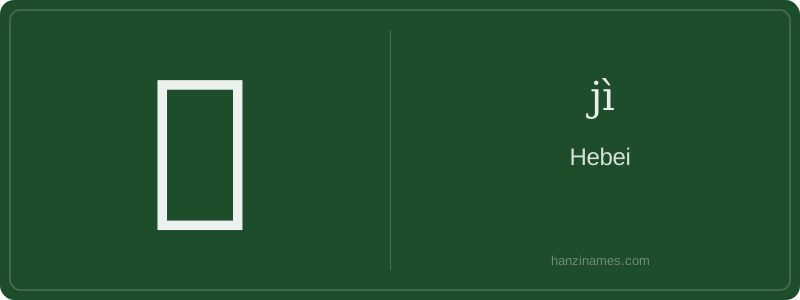
冀 is used daily in official contexts: license plates (e.g., 冀A for Shijiazhuang), government documents, news headlines ('冀南暴雨' — 'heavy rain in southern Hebei'), and weather reports. It appears in the standardized provincial abbreviation system adopted nationwide since the 1950s. Historically, 'Ji' was the name of a major state during the Zhou Dynasty and later one of the Ten Kingdoms; the Tang-era 'Ji Zhou' (Ji Prefecture) solidified its geographic association.
The character’s form evolved from seal script, where it combined 北 (north) and 田 (field), later acquiring the 八 radical. Modern dictionaries (e.g., *Xiandai Hanyu Cidian*, 7th ed.) confirm its origin as a phonosemantic compound with 北 as the semantic component (indicating northern location) and 異 (yì) as the original phonetic—later simplified to the current structure. No oracle bone form survives.
冀 (jì) is far more than a provincial abbreviation—it embodies China’s layered geography and historical consciousness. As the official shorthand for Hebei Province, it anchors modern administrative identity while echoing ancient regional names from the Warring States period, when ‘Ji’ referred to the northern heartland near today’s Beijing and Shijiazhuang. This character carries the weight of imperial roads, Yellow River floods, and Ming-Qing granaries—territory that shaped China’s political center for millennia.
The radical 八 (bā, 'eight') hints not at numerology but at divergence or extension—fitting for a province that fans out from the North China Plain into mountains, coast, and steppe margins. Its 16 strokes trace a subtle tension between containment and expansion: the upper part suggests a sheltered space (北 + 田), while the lower 八 implies outward reach—mirroring Hebei’s role as both shield and conduit for the capital.
In Chinese cosmology, place names are never neutral; they encode memory, aspiration, and relational positioning. 冀 subtly conveys hope—not just as a verb (a secondary meaning), but as a *geographic promise*: fertile land, strategic access, resilience. To write 冀 is to inscribe continuity—from ancient Yan and Zhao states to today’s Jing-Jin-Ji megalopolis—where history isn’t past tense, but infrastructure.
Example Sentences
Common Compounds
Similar Characters — Don't Mix These Up
Your First Step into Chinese Culture: Get a Chinese Name
Every journey into Chinese begins with a name. Use our free Chinese name generator to create a meaningful, personalized Chinese name that fits you perfectly.
Get My Chinese Name →