冓
Character Story & Explanation
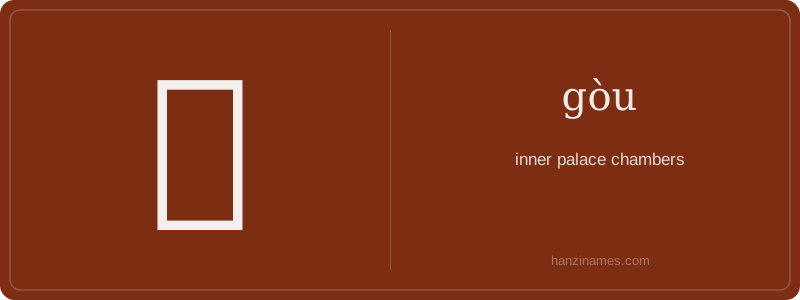
冓 is virtually obsolete as an independent character in modern Mandarin. It appears exclusively in historical texts, classical poetry, and as a component in phono-semantic compound characters (e.g., 構, 購, 絆). The Shuōwén Jiězì (121 CE), China’s earliest dictionary, defines 冓 as 'interlaced beams forming inner palace chambers'—confirming its architectural origin. No modern idioms or daily phrases use 冓 standalone; it survives only etymologically.
The character’s form—a symmetrical double '冂' (radical meaning 'downward enclosure') crossed by horizontal strokes—graphically represents overlapping roof trusses or intersecting walls. This pictographic origin is well-documented in bronze inscriptions from the Western Zhou dynasty (c. 1046–771 BCE), where 冓 appears in clan names and ritual vessel inscriptions referring to ancestral hall construction.
冓 (gòu) is an ancient Chinese character originally depicting two intersecting roof beams or interlocking architectural frames—symbolizing the inner, private chambers of palaces and aristocratic residences. Unlike common modern characters, 冓 rarely appears alone; it functions primarily as a phonetic or semantic component in compound characters like 構 (gòu, 'to construct') and 購 (gòu, 'to purchase'). Its meaning evokes spatial intimacy and hierarchical seclusion—spaces reserved for royalty, ancestral rites, or confidential affairs.
In traditional Chinese architecture, the 'inner rooms' denoted by 冓 weren’t merely physical spaces but socio-ritual zones: women’s quarters (內寢), ancestral halls, or emperor’s private audience chambers—parallel to Western concepts like the *oikos* in ancient Greece (the sacred domestic sphere) or the *penetralia* in Roman temples (innermost sanctum). These were not 'bedrooms' in the modern sense, but culturally charged domains of lineage, authority, and taboo.
Western equivalents include the 'sanctum sanctorum' (Holy of Holies) in Judeo-Christian tradition—the veiled inner chamber of the Temple—or the 'thronos' chamber behind the proscenium in Byzantine imperial palaces. Like 冓, these spaces were architecturally demarcated, access-restricted, and symbolically dense: their very structure encoded power, purity, and cosmological order. Thus, 冓 transcends architecture—it is a lexical artifact of China’s spatial ethics and hierarchical cosmology.
Example Sentences
Common Compounds
Similar Characters — Don't Mix These Up
Your First Step into Chinese Culture: Get a Chinese Name
Every journey into Chinese begins with a name. Use our free Chinese name generator to create a meaningful, personalized Chinese name that fits you perfectly.
Get My Chinese Name →