冕
Character Story & Explanation
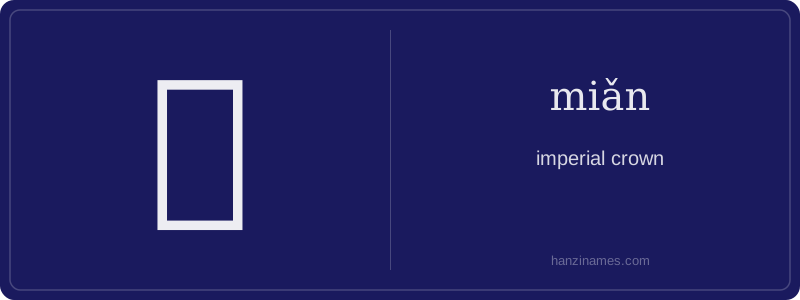
冕 appears in classical texts like the Rites of Zhou (Zhōu Lǐ) and the Book of Rites (Lǐjì), specifying strict rules for crown design based on rank — e.g., the emperor’s mian had 12 jade pendants, while dukes had 9. Today, it survives mainly in formal compounds like 冕旒 (miǎnliú, 'imperial crown') and idioms such as ‘冠冕堂皇’ (guān miǎn táng huáng), meaning ‘grand-sounding but insincere’. It’s also used reverently in modern academic or cultural discourse to denote ‘highest honor’ — e.g., ‘学术冕旒’ (academic crown).
The character’s earliest attested form appears in bronze inscriptions from the Western Zhou dynasty (c. 1046–771 BCE), showing a head covered by a rectangular board with vertical elements — matching archaeological finds of jade-beaded crowns. Its structure reflects actual regalia, not abstract invention.
Hi students! The character 冕 (miǎn) is a beautiful and historically rich word meaning 'ceremonial crown' — specifically the ancient Chinese royal headdress with a flat, horizontal board (called the 'yán') and hanging strings of jade beads. It’s not just any hat: it symbolized supreme authority and ritual purity in imperial China. Though rarely used in daily speech today, it appears in formal, literary, or historical contexts — like describing emperors, classical texts, or symbolic honors.
This character has 11 strokes and belongs to the 冂 (jiōng) radical — which originally depicted a 'hollow enclosure' or 'arched structure', fitting for a crown’s frame-like shape. Notice how the top part (冃) resembles a covering over the head, while the bottom (勉) hints at effort or solemn duty — reminding us that wearing the crown carried immense responsibility, not just privilege.
Don’t confuse 冕 with simpler words for 'hat' like 帽 (mào) or 冠 (guān). 冕 is exclusively ceremonial and hierarchical — reserved for emperors, high-ranking officials in rituals, or metaphorically for 'the highest honor'. Its tone is third (miǎn), so practice saying it with a falling-then-rising contour: like asking ‘Miǎn?’ with gentle emphasis. Mastering this character opens doors to classical poetry, historical dramas, and understanding Confucian ideals of virtue and leadership.
Example Sentences
Common Compounds
Similar Characters — Don't Mix These Up
Your First Step into Chinese Culture: Get a Chinese Name
Every journey into Chinese begins with a name. Use our free Chinese name generator to create a meaningful, personalized Chinese name that fits you perfectly.
Get My Chinese Name →