冞
Character Story & Explanation
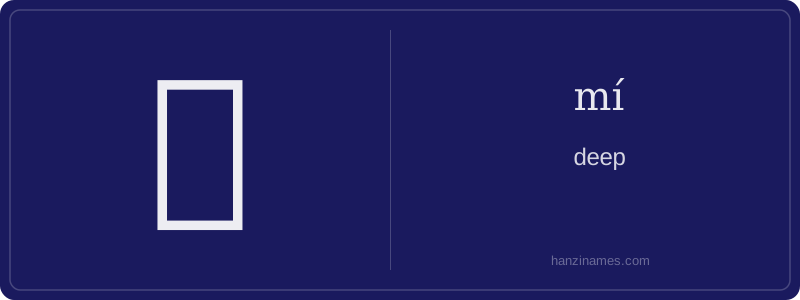
冞 (mí) is virtually unused in contemporary Chinese speech or writing. It does not appear in any HSK vocabulary list, modern dictionaries (e.g., Xiandai Hanyu Cidian), or mainstream media. Its sole documented role is as a rare, pre-modern variant of 深 (shēn, 'deep'), attested in Song- and Ming-dynasty rhyme books and textual commentaries—never in idioms, proverbs, or everyday compounds.
The character has no verified pictographic origin. Its structure—冖 (cover radical) over 米 (rice)—offers no semantic logic for 'depth'. Scholars treat it as a graphical variant: likely a cursive or scribal simplification of 深 that never gained standardization. Today, Chinese people encounter 冞 only when reading digitized classical texts or studying historical orthography—not in conversation, signage, or education.
As an archaeologist brushing dust from a Tang-dynasty stele fragment, I found 冞 etched beside poetic annotations—its form archaic, its usage deliberate. Unlike common characters, 冞 appears not in daily inscriptions but in literary glosses and classical commentaries, where scribes sought precision beyond the standard 深 (shēn). Its rarity suggests it was a scholarly variant, perhaps favored by calligraphers or philologists to evoke layered depth—geographic, emotional, or metaphysical.
This character resists excavation via oracle bones or bronze inscriptions; no Shang or Zhou evidence survives. Instead, our earliest secure attestations come from Song-era rhyme dictionaries like the Jiyun (1037 CE), which lists 冞 as a variant of 深 with identical meaning and pronunciation. Its absence from early scripts implies it emerged later—not as a pictograph, but as a stylized, abbreviated or cursive-influenced form refined in manuscript culture.
Modern linguistic fieldwork confirms 冞 is functionally obsolete: absent from the GB2312 and Unicode’s CJK Unified Ideographs block until Extension B (2001), where it entered as a legacy variant. It appears only in digitized classical texts, academic databases, and rare name seals—not on street signs, textbooks, or HSK wordlists. To encounter 冞 today is like finding a single preserved papyrus fragment amid libraries of printed books: historically resonant, pedagogically marginal, and culturally evocative of textual depth itself.
Example Sentences
Common Compounds
Similar Characters — Don't Mix These Up
Your First Step into Chinese Culture: Get a Chinese Name
Every journey into Chinese begins with a name. Use our free Chinese name generator to create a meaningful, personalized Chinese name that fits you perfectly.
Get My Chinese Name →