冫
Character Story & Explanation
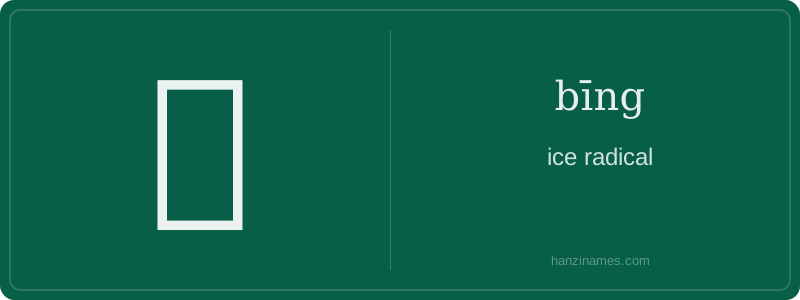
冫 is never used independently in modern Mandarin—it appears exclusively as a left-side radical in characters like 冰 (ice), 冷 (cold), 准 (to allow—originally 'to freeze standards' in legal texts), and 次 (order/sequence, historically linked to 'layers' or 'strata', evoking icy stratification). Historically, it appears in Han dynasty bamboo slips and Tang dynasty dictionaries like the Kangxi Zidian, classified under Radical 15 (the 'ice' radical). Crucially, it’s one of only two radicals composed of exactly two strokes—making it foundational for handwriting pedagogy.
The form 冫 originates as a cursive simplification of the top portion of 氷 (ancient ‘ice’), attested in clerical script (Lìshū) fragments from the Western Han. Its two downward-right strokes are not arbitrary: they mirror the crystalline symmetry of frost patterns—a documented visual motif in Song dynasty ink paintings and imperial ice-storage records.
As a detective tracing the evolution of 冫, I begin at the crime scene: the earliest standardized Chinese script—the Small Seal Script (c. 220 BCE). There, 冫 does not appear as an independent character but emerges solely as a *radical*—a structural clue embedded in characters related to cold, ice, or freezing. Its two-dot form is a stylized abbreviation of 氷 (bīng), the ancient variant of 冰, where the full water radical (氵) was paired with ‘ice’ (仌) — itself a doubled ‘person’ shape representing frozen crystals. Over centuries, scribes streamlined this into the minimalist, two-dot 冫 we see today.
This radical wasn’t born from scratch—it’s a forensic reduction. In oracle bone and bronze inscriptions, cold concepts were expressed through full pictographs like 冰 (ice) or 凝 (to congeal), often using water + solid/layered elements. By the Han dynasty, calligraphers began compressing recurring components for efficiency: the lower part of 氷—two short, descending strokes—was isolated and canonized as 冫. It never stood alone in classical texts; its existence is purely functional, like a fingerprint left on dozens of characters—not a suspect, but a signature of semantic intent.
Modern linguists confirm 冫 has no independent lexical meaning outside its role as a semantic indicator. Unlike radicals such as 木 (wood) or 心 (heart), which can appear as standalone characters, 冫 exists only in compound forms. Its ‘pronunciation’ bīng is borrowed from its most iconic host, 冰—like calling a prefix by the word it modifies. Even its nickname 兩點水 (‘two-dot water’) is descriptive, not etymological: those dots aren’t water droplets, but abstracted ice crystals—frozen shorthand for low temperature, clarity, stillness, and sometimes, emotional detachment in literary usage.
Example Sentences
Common Compounds
Similar Characters — Don't Mix These Up
Your First Step into Chinese Culture: Get a Chinese Name
Every journey into Chinese begins with a name. Use our free Chinese name generator to create a meaningful, personalized Chinese name that fits you perfectly.
Get My Chinese Name →