凋
Character Story & Explanation
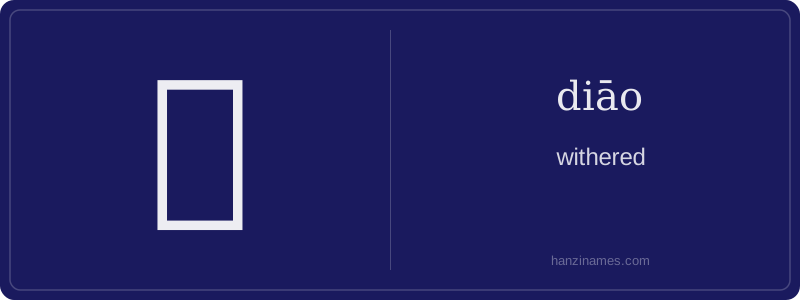
凋 appears frequently in literary and formal contexts—especially in idioms like 凋零 (diāo líng, 'to wither and fall'), used historically to describe fallen dynasties, declining lineages, or eroded moral standards. It’s common in modern media when discussing ecological degradation (e.g., 生物多样性凋零, 'biodiversity decline') or cultural erosion. Unlike colloquial terms like 枯 (kū), 凋 carries poetic gravity and is rarely used in casual speech.
The character’s form combines 冫 (ice radical, suggesting cold-induced decay) and 周 (zhōu, phonetic component, originally meaning 'to surround' or 'cycle'). Per the *Shuōwén Jiězì* (121 CE), it was defined as 'plants losing vitality due to cold,' confirming its agrarian origin. No oracle-bone or bronze inscriptions survive for 凋, but its earliest attested use appears in Han dynasty texts describing seasonal crop failure.
凋 (diāo) embodies a quiet, profound aspect of the Chinese worldview: the natural, inevitable decline that follows flourishing. Unlike Western narratives often fixated on perpetual growth or heroic resistance to decay, classical Chinese thought—rooted in Daoist and Confucian sensibilities—sees withering not as failure, but as a necessary phase in cyclical harmony (yīn-yáng balance). Autumn’s falling leaves, fading blossoms, or dimming candlelight all carry poetic weight precisely because they signal transition, not termination.
This character reflects a cultural comfort with impermanence—what the Japanese call *mono no aware*, though in Chinese tradition it’s more philosophically grounded in seasonal rhythm (*sìshí*) and agricultural wisdom. In poetry from the Tang and Song dynasties, 凋 evokes poignant beauty in loss: a withered orchid symbolizes loyal scholars dismissed from court; frost-bitten plum branches signify integrity enduring hardship. The aesthetic isn’t melancholy for its own sake—it’s reverence for authenticity amid change.
Importantly, 凋 rarely stands alone in modern usage; it functions almost exclusively in compound words, reinforcing collectivist linguistic logic—meaning emerges through relational context, not isolated glyphs. Its radical 冫 (ice) hints at cold-induced decline, subtly linking climate, emotion, and fate. Thus, 凋 is less about ‘death’ than about dignified, seasonally sanctioned release—a reminder that letting go can be an act of alignment with cosmic order, not surrender.
Example Sentences
Common Compounds
Similar Characters — Don't Mix These Up
Your First Step into Chinese Culture: Get a Chinese Name
Every journey into Chinese begins with a name. Use our free Chinese name generator to create a meaningful, personalized Chinese name that fits you perfectly.
Get My Chinese Name →