凵
Character Story & Explanation
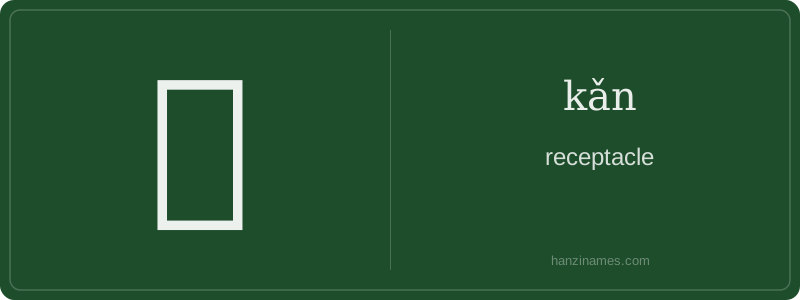
凵 is virtually never used independently in modern Mandarin; it functions solely as a radical (Radical 17) and appears in dictionaries as a component, not a standalone lexical item. It is included in the Kangxi Dictionary (1716) and remains part of the official GB2312 and Unicode character sets. You’ll encounter it only inside characters — never in textbooks, conversations, or signage as a free-standing word.
Historically, 凵 is a verified pictograph from oracle bone and bronze inscriptions (c. 1200 BCE), clearly representing an open-mouthed container or depression in the ground — a pit, trench, or basin. Archaeological evidence confirms such excavated features were vital in Shang dynasty ritual contexts, including storage, burial, and divination pits. This literal ‘receptacle’ meaning is preserved structurally in later characters.
凵 (kǎn) is one of the most ancient Chinese characters — a rare two-stroke radical that visually embodies an open container or hollow space. Unlike most modern characters, it survives almost exclusively as a component in compound characters rather than as an independent word. Its shape — a downward-facing U — directly evokes receptacles like bowls, pits, or basins, reflecting early Chinese writing’s strong pictographic roots.
This character appears in over 40 standard Chinese characters, including 函 (hán, 'box' or 'letter'), 出 (chū, 'to go out', originally depicting feet stepping from a pit), and 凶 (xiōng, 'inauspicious', showing a man in a pit — historically linked to omens). Though not used alone in speech, its structural presence reinforces semantic meaning across many words related to containment, emergence, or enclosure.
In Western cultural terms, 凵 parallels archetypal symbols like the chalice (Christianity), the cauldron (Celtic/alchemy), or the Greek krater — all signifying receptivity, transformation, or sacred containment. Yet unlike those culturally loaded objects, 凵 is purely functional and abstract in Chinese script: a silent architectural element of meaning, not a vessel for myth or ritual. Its power lies in linguistic scaffolding, not symbolic storytelling.
Example Sentences
Common Compounds
Similar Characters — Don't Mix These Up
Your First Step into Chinese Culture: Get a Chinese Name
Every journey into Chinese begins with a name. Use our free Chinese name generator to create a meaningful, personalized Chinese name that fits you perfectly.
Get My Chinese Name →