刂
Character Story & Explanation
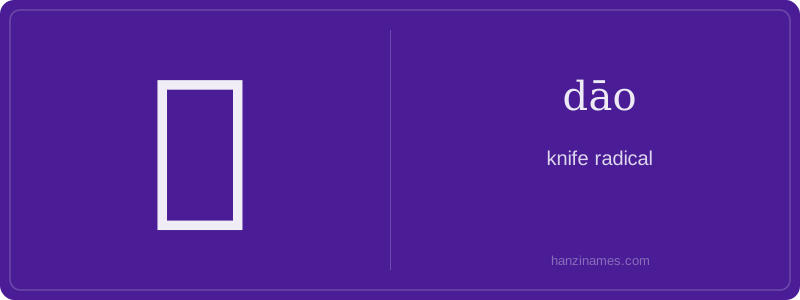
刂 is indispensable in modern Chinese typography and lexicography: it serves as Radical 18 in the Kangxi Dictionary system still used in print dictionaries, digital input methods, and HSK vocabulary indexes. Over 150 characters contain 刂 — including high-frequency words like 切 (qiē, 'to cut'), 判 (pàn, 'to judge'), and 列 (liè, 'to list'). The idiom 明察秋毫 (míng chá qiū háo, 'to perceive the finest details') uses 刻 (kè) — whose 刂 component reinforces precision, like a sharp tool carving fine distinctions.
The form 刂 evolved from the ancient pictograph 刀 (knife), simplified by removing the handle to become a pure right-side radical. By the Han dynasty (206 BCE–220 CE), scribes standardized 刂 for compactness in vertical column writing — a practical adaptation confirmed in excavated bamboo slips and Shuowen Jiezi (100 CE).
Hello, learners! Today we’re exploring 刂 — not a standalone word you’ll use in speech, but a crucial building block: the 'vertical knife' radical. Pronounced dāo (like 'dow' in 'downtown'), it’s called 立刀旁 (lì dāo páng) or 側刀旁 (cè dāo páng), meaning 'standing knife side-element'. It appears only on the right side of characters and signals meanings related to cutting, slicing, or sharp action — think knives, blades, or decisive acts.
This radical has just two strokes: a short downward stroke (丨), then a sharp, angled hook (亅) — like a knife blade viewed from the side. Though it looks simple, mastering its shape helps you recognize dozens of common characters, from 利 (lì, 'sharp/advantageous') to 刻 (kè, 'to engrave'). It’s one of the 214 Kangxi radicals — the foundational categories used in traditional Chinese dictionaries.
Don’t confuse 刂 with the full character 刀 (dāo, 'knife') — they share origin but differ functionally. 刀 is an independent character you can say and write alone; 刂 is *only* a radical, never used solo. Think of it like a 'prefix' in English grammar — silent on its own but vital for meaning. In handwriting, always write it last when it appears on the right — a key rule for correct stroke order!
Example Sentences
Common Compounds
Similar Characters — Don't Mix These Up
Your First Step into Chinese Culture: Get a Chinese Name
Every journey into Chinese begins with a name. Use our free Chinese name generator to create a meaningful, personalized Chinese name that fits you perfectly.
Get My Chinese Name →