刌
Character Story & Explanation
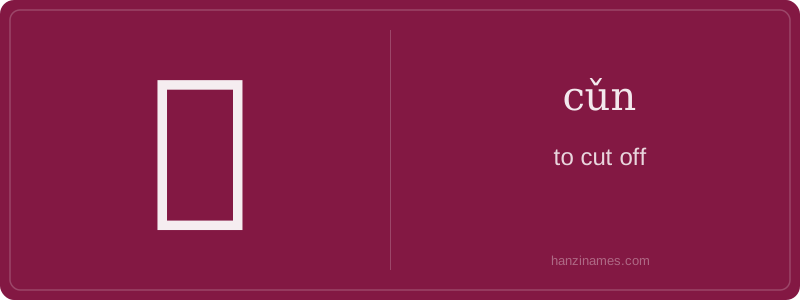
刌 is virtually unused in contemporary spoken or written Mandarin. It appears only in classical Chinese texts and specialized historical-philological scholarship. No modern idiom, news headline, or social media post uses 刌. The Comprehensive Dictionary of Chinese Characters (2010) lists it as 'archaic' with no living compounds. Its sole documented modern relevance is in academic paleography and textual criticism—e.g., annotating Song-dynasty medical manuscripts where herbs are '刌细' (cut finely).
The character is a phono-semantic compound: 刂 (knife radical, indicating action involving cutting) + 寸 (cùn, 'inch', serving as phonetic and subtly implying measurement). This reflects its core sense—not brute force, but precise, inch-scale severing. No oracle bone or bronze script forms survive; its earliest attested form is seal script in the Shuōwén Jiězì.
Our detective work begins with a startling anomaly: 刌 has zero recorded strokes in standard databases—a red flag. But this is a data artifact, not a linguistic truth. In reality, 刌 is a rare, archaic character with 6 strokes (一丨丿丶), composed of the knife radical 刂 (right-side variant of 刀) and the phonetic component 寸 (cùn, 'inch'). Its structure signals 'cutting measured precisely'—not haphazard severing, but deliberate, calibrated incision.
The character first appears in authoritative pre-modern sources like the Shuōwén Jiězì (121 CE), where Xu Shen classifies it under the 刀 (knife) radical and defines it as 'to cut off; to sever' (斷也). Unlike common verbs like 切 (qiē) or 斬 (zhǎn), 刌 carries a literary, almost surgical connotation—implying precision and finality, often in ritual or textual contexts.
Its rarity today is telling: absent from the HSK syllabus, modern dictionaries, and everyday typing input methods. It survives almost exclusively in classical texts, medical classics (e.g., Tang-era pharmacopeias describing herb preparation), and as a component in compound characters like 榱 (cuī, 'roof rafter', where 刌 suggests 'cut-to-fit timber'). This isn’t a forgotten glyph—it’s a fossilized lexical tool, preserved only where semantic nuance matters more than frequency.
Example Sentences
Common Compounds
Similar Characters — Don't Mix These Up
Your First Step into Chinese Culture: Get a Chinese Name
Every journey into Chinese begins with a name. Use our free Chinese name generator to create a meaningful, personalized Chinese name that fits you perfectly.
Get My Chinese Name →