刖
Character Story & Explanation
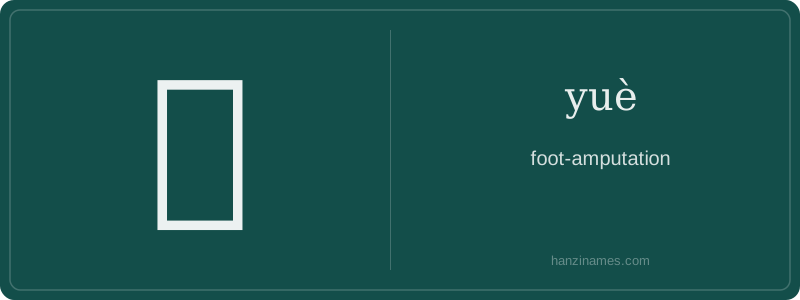
刖 is virtually absent from modern spoken or written Chinese. It appears exclusively in classical historical texts, legal histories, and academic discussions of ancient penal systems—never in contemporary media, education, or conversation. No HSK list includes it; it carries no colloquial usage, idioms, or set phrases in living language. Its sole real-world relevance today is scholarly: historians cite it when analyzing Qin legal codes or interpreting excavated bamboo manuscripts like the Shuihudi Qin Statutes.
The character’s form is not pictographic but phono-semantic: the right-side 刂 (knife radical) conveys meaning related to cutting, while the left-side 月 (yuè) serves as the phonetic component—though its sound has shifted over millennia. There is no oracle-bone or bronze inscription attesting to an earlier pictorial origin; earliest secure attestations are in Warring States bamboo texts and Qin wooden slips.
As an archaeologist brushing dust from a Warring States bamboo slip, I first encountered 刖 not as a word—but as a scar on history. Carved with stark, angular strokes, it appears in legal texts from the Qin dynasty (221–206 BCE), where it denoted one of the ‘Five Punishments’—a judicial amputation of feet, intended to disable but not kill. Its presence signals state power inscribed on the body: a grim administrative act made visible through script.
This character is not abstract philosophy—it’s forensic evidence. Excavated at Shuihudi and Liye, 刖 appears alongside detailed records of convicted artisans, whose maimed hands or feet were noted before assignment to state workshops. The radical 刂 (knife) anchors its meaning in physical violence, while the phonetic component 月 (yuè) provides pronunciation without softening its severity. No gentle metaphor here—only law, limb, and ledger.
Unlike poetic characters that evolved into abstraction, 刖 fossilized its function. It never entered daily speech or idioms; instead, it remained confined to juridical archives and historiographical censure—like Sima Qian’s condemnation of Qin cruelty in the *Shiji*. Its six strokes are minimalist, almost brutal: two vertical cuts (刂), a horizontal bar, and the skeletal frame of 月—suggesting containment, restriction, and irreversible consequence. This is orthography as indictment.
Example Sentences
Common Compounds
Similar Characters — Don't Mix These Up
Your First Step into Chinese Culture: Get a Chinese Name
Every journey into Chinese begins with a name. Use our free Chinese name generator to create a meaningful, personalized Chinese name that fits you perfectly.
Get My Chinese Name →