刵
Character Story & Explanation
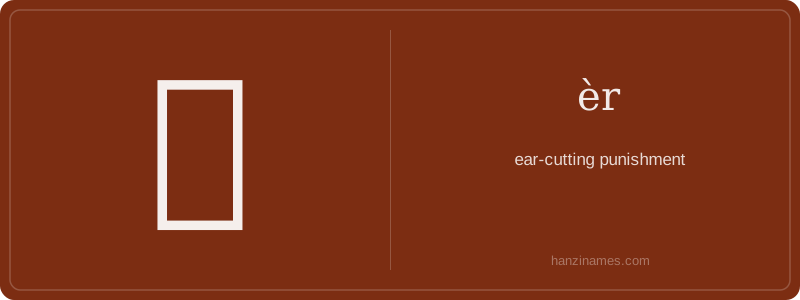
刵 appears historically in early Chinese legal codes, notably as one of the Five Punishments (五刑) documented in texts such as the 'Rites of Zhou' (《周礼》) and 'Book of Rites' (《礼记》). It was formally abolished after the Han dynasty, replaced by fines or exile. No modern idiom, phrase, or compound uses 刵 — it has zero presence in dictionaries like the Xiandai Hanyu Cidian or online corpora (e.g., BCC or COCA). You will not find it on signs, in textbooks, or in media.
The character’s form combines the radical ⺼ (flesh/body) on the left and 耳 (ear) on the right — a clear semantic-phonetic compound: ⺼ indicates bodily harm, 耳 specifies the organ targeted. This structure is well-documented in Shuōwén Jiězì (c. 100 CE), where Xu Shen defines it explicitly as 'cutting off the ears.' There is no pictographic origin — it's a logical, later-formed character for a specific legal concept.
Hello, learners! Today we’re looking at the character 刵 (èr), which is a rare and ancient word meaning 'to cut off the ears as punishment.' It’s not used in modern spoken or written Chinese — you won’t hear it in daily conversation, news, or social media. Instead, it appears almost exclusively in classical texts, historical records, and legal terminology from pre-Qin and Han dynasty China. Its meaning reflects one of the 'Five Punishments' (五刑) — corporal penalties administered for serious crimes.
This character is highly specialized: it carries no emotional or metaphorical extensions in contemporary usage, unlike more common characters with body-related radicals. It belongs to a category of archaic legal vocabulary that scholars study but native speakers rarely encounter. Even advanced learners may go years without seeing it outside academic contexts like history, law, or paleography courses.
As a teacher, I emphasize that 刵 is *not* part of HSK vocabulary at any level — not HSK 1 through 6, nor even the extended HSK 7–9 list. Its inclusion here is for cultural literacy and historical awareness, not practical communication. If you're reading classical legal texts like the Book of Rites (《礼记》) or Han dynasty bamboo slips, you might meet 刵 — but otherwise, treat it like a museum artifact: fascinating, instructive, and intentionally preserved — not actively used.
Example Sentences
Common Compounds
Similar Characters — Don't Mix These Up
Your First Step into Chinese Culture: Get a Chinese Name
Every journey into Chinese begins with a name. Use our free Chinese name generator to create a meaningful, personalized Chinese name that fits you perfectly.
Get My Chinese Name →