刭
Character Story & Explanation
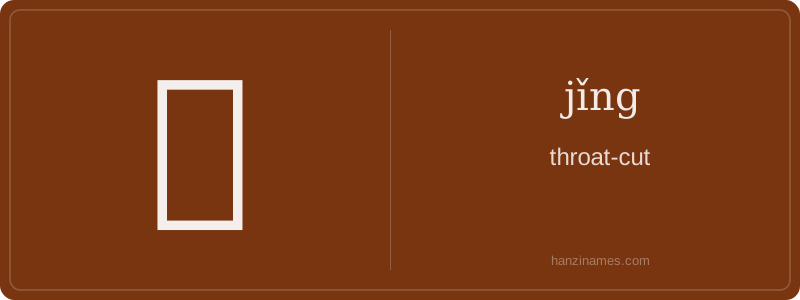
In documented historical usage, 刭 appears in authoritative sources like Sima Qian’s *Records of the Grand Historian* (Shǐjì), where figures like General Xiang Yu’s followers are recorded committing 自刭 after defeat — a culturally coded act of loyalty and shame-avoidance. Today, the character survives only in fixed literary expressions, especially 自刭 and 赐刭 (cì jǐng, 'ordered to commit throat-cutting', a form of imperial execution). It is absent from spoken Mandarin and modern legal terminology, replaced by neutral terms like 死亡 (sǐwáng, 'death') or 自杀 (zìshā, 'suicide').
The character’s form combines the knife radical 刂 (indicating cutting action) with 井 (jǐng, 'well') as a phonetic component. No pictographic origin exists — it is a phono-semantic compound standardized in the Qin dynasty’s small seal script. Its shape bears no visual resemblance to a throat or knife; its meaning derives entirely from textual tradition, not visual symbolism.
The character 刭 (jǐng) is a rare, literary term meaning 'to cut the throat' — not used in everyday speech but preserved in classical texts, historical narratives, and formal writing. Its sharp, decisive meaning evokes finality and violence, often tied to acts of honor, rebellion, or execution in pre-modern China. The radical 刂 (knife) signals its association with cutting, while the phonetic component 井 (jǐng, 'well') hints at pronunciation but carries no semantic link to wells.
This character appears almost exclusively in set phrases like 自刭 (zì jǐng, 'to slit one’s own throat'), historically associated with officials or warriors choosing death over surrender or disgrace. Unlike common verbs like 杀 (shā, 'to kill'), 刭 emphasizes method and agency — a deliberate, close-range act with ritual or moral weight. It reflects Confucian-era values where bodily integrity and loyalty dictated extreme choices.
Modern usage is highly restricted: you’ll find 刭 in history textbooks, classical poetry anthologies, or legal-historical analyses — never on menus, signs, or social media. Even native speakers may hesitate when reading it aloud without context. Its rarity makes it a marker of advanced literacy; it’s absent from all HSK levels (not listed in HSK 1–6 word lists), underscoring its status as a specialized, archaic term rather than a functional part of contemporary Mandarin.
Example Sentences
Common Compounds
Similar Characters — Don't Mix These Up
Your First Step into Chinese Culture: Get a Chinese Name
Every journey into Chinese begins with a name. Use our free Chinese name generator to create a meaningful, personalized Chinese name that fits you perfectly.
Get My Chinese Name →