剋
Character Story & Explanation
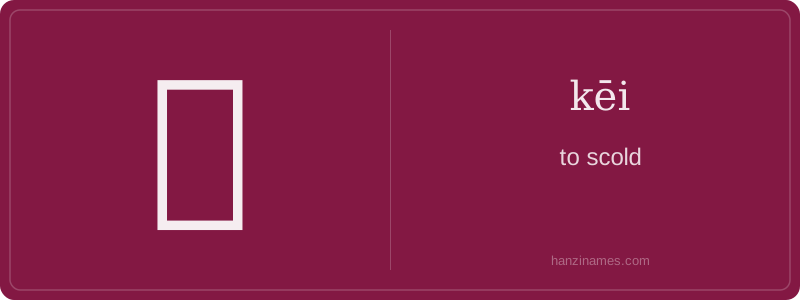
剋 is widely used in contemporary northern Chinese speech — especially in Beijing, Tianjin, and Heilongjiang — to describe heated, direct scolding, often by parents, teachers, or elders. It appears in popular media: for example, the phrase '别剋孩子了' ('Don’t scold the child so harshly!') is common in parenting discussions on Weibo and Douyin. Though not in HSK lists, it’s documented in the Xiandai Hanyu Cidian (7th ed., 2016) as a colloquial verb with emphasis on severity and immediacy.
The character is a phono-semantic compound: the left component 克 (kè) provides sound and conveys 'to overcome/control', while the right radical 刂 (knife) signals action and sharpness — consistent with its meaning of incisive verbal force. No oracle-bone or bronze inscription evidence exists for 剋; it emerged later in vernacular writing, likely during the Ming–Qing period, as a phonetic variant emphasizing oral reprimand.
剋 (kēi) is a colloquial, forceful verb meaning 'to scold harshly' or 'to reprimand severely', often implying emotional intensity, moral disapproval, or parental/authoritative discipline. Unlike neutral terms like 批评 (pīpíng, 'to criticize'), 剋 carries visceral weight — it’s the sharp, stinging rebuke delivered in frustration, not detached analysis. It appears frequently in northern Mandarin dialects and informal speech, especially in Beijing and Northeast China, where tone and rhythm amplify its impact.
This character reflects a culturally embedded view of verbal correction as an act with physical resonance — the radical 刂 (knife) visually reinforces its cutting, incisive nature. While English has no single-word equivalent, phrases like 'to tear into someone', 'to chew out', or 'to dress down' come closest in register and emotional charge. However, 剋 lacks the bureaucratic or professional connotation of 'dress down'; it’s more familial, spontaneous, and emotionally charged.
In contrast to Western individualistic norms that often prioritize constructive feedback or psychological safety, 剋 embodies a relational, hierarchy-aware mode of communication where stern verbal correction signals care, responsibility, or boundary enforcement — especially within families or close-knit groups. It’s rarely used toward strangers or superiors, underscoring its context-bound, interpersonal function. Its informality and regional prevalence mean it’s absent from formal documents or standard HSK curricula, making it a living example of how spoken language preserves cultural attitudes toward authority and affection.
Example Sentences
Common Compounds
Similar Characters — Don't Mix These Up
Your First Step into Chinese Culture: Get a Chinese Name
Every journey into Chinese begins with a name. Use our free Chinese name generator to create a meaningful, personalized Chinese name that fits you perfectly.
Get My Chinese Name →