剒
Character Story & Explanation
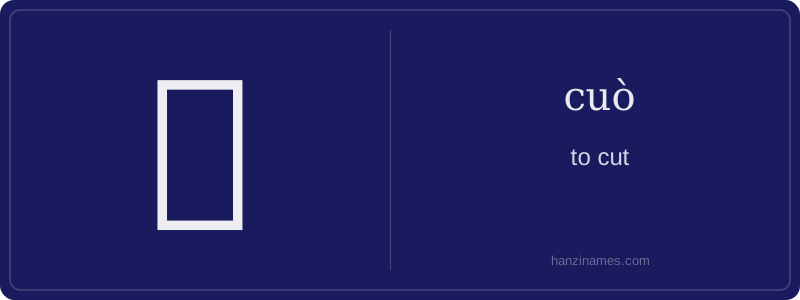
剒 is exceptionally rare in modern spoken and written Mandarin. It does not appear in any HSK level, nor in the Xiàndài Hànyǔ Chángyòng Zìbiǎo (Standard List of Common Modern Chinese Characters). It is absent from contemporary dictionaries like the Xiàndài Hànyǔ Cídiǎn (5th ed., 2005) and appears only in specialized classical references such as the Kāngxī Zìdiǎn (1716), where it is defined as 'to cut off; to trim' (削也) and cited in fragments of Han dynasty bamboo-slip texts and Tang-Song literary commentary on textual emendation.
The character’s form combines the ‘knife’ radical (刂) on the right and the phonetic component 昔 (xī) on the left—a common structure for phono-semantic compound characters. While 昔 originally depicted dried meat under the sun (a pictograph for 'past'), here it serves purely for sound. No verified oracle bone or bronze inscription of 剒 exists; its earliest confirmed attestation is in Eastern Han philological works, used almost exclusively in technical contexts of textual revision or ritual purification.
剒 (cuò) is a rare, classical Chinese character meaning 'to cut'—not in the everyday sense of slicing food or paper, but with precision, force, and intentionality, often implying removal, trimming, or even punishment. Its rarity reflects a deeper cultural principle: language preserves only those actions deemed ritually, legally, or technically significant across centuries. In pre-modern China, cutting wasn’t merely physical—it carried moral weight, as in cutting away excess (luxury, error, corruption), echoing Confucian ideals of self-cultivation and Daoist notions of pruning for harmony.
This character embodies the Chinese worldview where verbs are not neutral tools but ethical acts. To 剒 is to intervene decisively—like a judge severing injustice, a carpenter removing flawed timber, or a scholar excising erroneous passages from a text. Unlike common cutting verbs like 切 (qiē) or 割 (gē), 剒 connotes authoritative, irreversible action—often documented in legal statutes or textual criticism, not marketplaces or kitchens.
Its near-absence from modern speech underscores how Chinese linguistic ecology conserves lexical fossils that encode historical values. When 剒 appears today—in scholarly editions, classical poetry annotations, or paleographic studies—it functions less as vocabulary and more as a cultural artifact: a silent witness to how ancient China conceptualized precision, discipline, and the moral gravity of removal. To encounter 剒 is to glimpse a worldview where language itself is carved—not written, but chiseled—with purpose.
Example Sentences
Common Compounds
Similar Characters — Don't Mix These Up
Your First Step into Chinese Culture: Get a Chinese Name
Every journey into Chinese begins with a name. Use our free Chinese name generator to create a meaningful, personalized Chinese name that fits you perfectly.
Get My Chinese Name →