刿
Character Story & Explanation
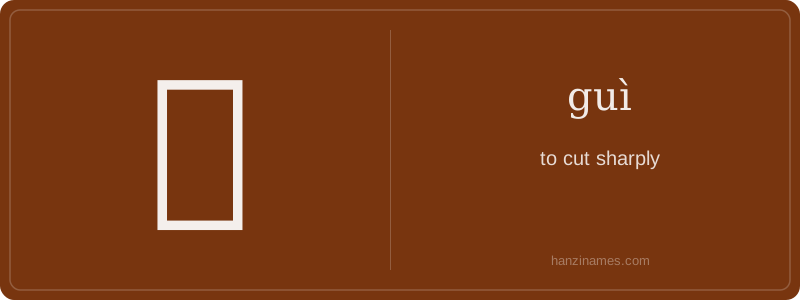
刿 is virtually unused in modern spoken Chinese but survives in classical idioms and literary criticism. The most documented usage is in the idiom 刿目怵心 (guì mù chù xīn), recorded since the Ming dynasty to describe writing or art so stark and incisive that it ‘cuts the eyes and startles the heart’—a phrase still cited in literary reviews and university courses on classical prose. It also appears in historical texts like the Zuo Zhuan, where it describes decisive, ritualized cuts in political or military contexts.
The character’s form combines the knife radical 刂 (indicating cutting action) with 岁 (suì) as a phonetic component. While 岁 originally depicted an axe cutting grain (in oracle bone script), its role here is purely phonetic—no semantic connection to ‘years’. Today, Chinese learners encounter 刿 almost exclusively through this idiom, not daily life—making it a marker of advanced classical literacy rather than practical communication.
刿 (guì) is a relatively rare but precise character meaning 'to cut'—not in the casual sense of slicing fruit, but with surgical sharpness or decisive force. Its radical 刂 (knife) signals action involving a blade, while the phonetic component 岁 (suì, meaning 'year') hints at pronunciation without semantic link. Historically, it appears in classical texts describing clean, incisive cuts—often metaphorical, like cutting through confusion or falsehood.
This character embodies precision and finality: not hacking or chopping, but a single, controlled severance. In ancient warfare or ritual, such a cut could signify execution, sacrifice, or boundary-setting. Its rarity today reflects how modern Mandarin favors more common synonyms like 切 (qiē) or 割 (gē) for everyday cutting—but 刿 retains literary weight and moral gravity.
Because 刿 appears almost exclusively in fixed classical expressions—not as a standalone verb—it’s best learned contextually. It rarely occurs in spoken Mandarin or beginner textbooks, which explains its absence from HSK lists. Yet encountering it in idioms like 刿目怵心 reveals its enduring power: a cut so vivid it pierces the eye and shocks the heart, evoking visceral clarity or moral awakening.
Example Sentences
Common Compounds
Similar Characters — Don't Mix These Up
Your First Step into Chinese Culture: Get a Chinese Name
Every journey into Chinese begins with a name. Use our free Chinese name generator to create a meaningful, personalized Chinese name that fits you perfectly.
Get My Chinese Name →